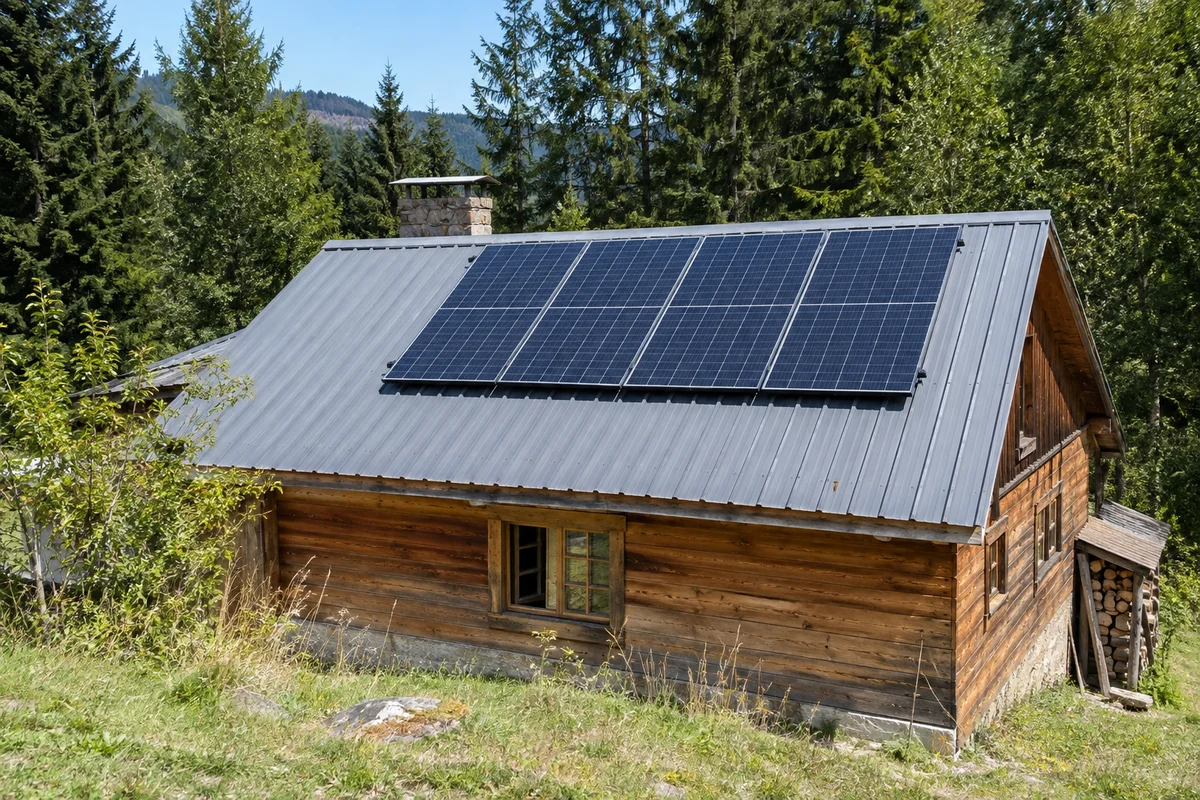
A solar kit should solve a specific power problem: keeping your fridge cold, lights on and devices charged for the time you spend at the cabin. Its advertised panel wattage tells you only part of that story.
You need enough daily generation, enough stored energy for the gaps, and equipment that can run your appliances together. You also need the parts that connect, protect and mount everything. A box described as “complete” still has to fit your building.
Use this guide to compare kit contents and prepare questions for a supplier or installer. For your starting consumption figures, work through the off-grid energy audit.
Choose the kind of kit first
A panel-and-controller kit may suit someone who already has compatible batteries and a designed distribution system. Check the packing list before assuming storage or AC outlets are included.
A component system has separate panels, charge control, batteries and, where needed, an inverter. You can specify these around a permanent cabin installation, but someone must verify that the complete design works.
A portable power station with solar panels packages several functions inside one unit. It can be convenient when the equipment travels home between visits. Check usable energy, output limits and solar input rather than treating every bundle as equivalent.
For example, EcoFlow lists the US DELTA 3 Plus — opens Amazon US in a new tab with 1,024 Wh nominal capacity and 1,800 W output. Those numbers describe stored energy and output power respectively; neither tells you how much electricity its panels will collect at your cabin. EcoFlow US specifications.
Size a day before shopping for watts
Here is a fictional weekend-cabin load list. Every figure is an assumption for demonstrating the method, not a tested appliance result.
- Refrigerator: Assumed daily consumption; 450 Wh.
- LED lights: 18 W combined for 4 hours; 72 Wh.
- Laptop: 40 W for 3 hours; 120 Wh.
- Phones: Assumed charging total; 40 Wh.
- Water pump: 60 W for 15 minutes; 15 Wh.
- Router: 10 W for 12 hours; 120 Wh.
- Appliance subtotal: 817 Wh.
- Illustrative allowance: Conversion losses, system overhead and uncertainty; 183 Wh.
- Planning total drawn from storage: 1,000 Wh/day.
That allowance is not a universal efficiency factor. Replace it with equipment-specific estimates, including inverter idle draw and any loads that stay on while you are away. Electric heating, hot water and cooking are absent from this example. Adding them means recalculating the system.
Next, suppose you want two occupied days without useful solar charging. The example needs 2,000 Wh of usable stored energy. If, solely for planning, you allow 80% of nominal battery capacity to be used:
2,000 Wh ÷ 0.80 = 2,500 Wh nominal storage.
That assumed usable fraction must be checked against the actual battery, temperatures and reserve policy. The appliance-to-storage losses are already included in the daily total; do not silently count them twice.
Now try an assumed 600 W array with three peak-sun-hours and a 75% overall yield factor from panel rating to usable charging energy:
600 W × 3 hours × 0.75 = 1,350 Wh/day.
Peak-sun-hours express an equivalent amount of full-strength sunlight, not the time between sunrise and sunset. These inputs are invented for the example. Your site's seasonal sunlight, shade, orientation and system losses must replace them.
The result leaves only 350 Wh/day after the assumed daily consumption. Recovering a 2,000 Wh battery deficit while continuing normal use would therefore take about six such days. Battery charging limits or worse weather could extend that.
This is why a kit that balances an average day may still disappoint after a cloudy weekend. Explore that trade-off in batteries, solar and cloudy days.
Turn the packing list into a complete bill of components
Make a copy of this checklist for each kit. Fill in the exact model, quantity, included status and missing cost. “Included” is only useful when the part suits your installation.
- Solar panels: Model, quantity, dimensions, rated power and electrical data.
- Mounting system: Suitable structure, fixings, weather exposure and roof penetrations.
- Solar charge controller: Supported battery voltage, PV voltage/current limits and charging profile.
- Battery bank: Nominal and usable energy, allowed current, temperature limits and configuration.
- Inverter, if AC is needed: Correct AC supply, continuous output, starting-load capability and idle draw.
- Battery charger, if required: Compatibility with the battery and intended backup supply.
- Cables, terminals and connectors: Correct system ratings, actual route lengths and matching connections.
- Protection and isolation: Appropriate DC/AC devices for every relevant circuit.
- Distribution and enclosure: Load connections, protected terminals, access and environmental suitability.
- Monitoring: A practical way to see battery condition, use and charging.
- Installation and commissioning: Design review, mounting, configuration, verification and documentation.
The value of the checklist is what it exposes. A controller cable may be included but too short. A battery monitor may be present while an enclosure is absent. A solar bundle may exclude the inverter entirely.
Renogy's US 400 W shed/workshop kit page offers different battery variants. Its “With 3.6kWh Deep Cycle AGM Batteries” packing list includes panels, controller, three 12 V 100 Ah AGM batteries, inverter, mounting brackets, cables and monitoring. Select that variant to inspect this example; the page may initially show the lithium version. It still needs evaluation against your site and use. This is a documentation example, not a recommendation or a claim that the package matches the fictional cabin above. Renogy kit contents.
Check compatibility at each connection
Start with panels to controller. The array must meet the controller's voltage and current limits. Open-circuit voltage rises in colder conditions, so using only the panels' Voc at standard test conditions is insufficient. The panel temperature coefficient and expected minimum temperature matter. Victron's installation guidance explicitly requires this check. SmartSolar installation manual.
Controller names can also conceal different limits. The SmartSolar 100/30, for example, specifies a 100 V maximum PV open-circuit voltage and 30 A rated charging current. Its nominal PV power differs between 12 V and 24 V battery systems. These are separate quantities, not interchangeable “amps.” Victron technical specifications.
Then check controller to battery: supported voltage, battery chemistry, charge settings and allowed charging current. Confirm how charging is stopped when the battery cannot accept it.
Check battery to inverter for the complete load, including startup. A large inverter label does not guarantee the battery can supply its full output.
For scale, an assumed 1,500 W AC load at 90% inverter efficiency would require about 139 A from a 12 V supply:
1,500 W ÷ 0.90 ÷ 12 V ≈ 139 A.
At an assumed 24 V, the same calculation gives about 69 A. These are explanatory figures, not cable or fuse specifications. Actual supply voltage, surge behavior and equipment limits change the requirements.
Cables and protection must be selected together for the real installation. Victron's wiring reference distinguishes current, voltage and interrupt ratings when discussing fuse selection; an AC-rated device or a convenient cable size is not automatically suitable for a battery circuit. Wiring Unlimited.
Plan for the cabin when nobody is there
Walk the site in the season you expect to use it. Trees, roof shape and nearby structures can change useful solar exposure. DOE identifies location, orientation and shading among the factors affecting rooftop potential. A supplier's generic daily-production example cannot replace that assessment. DOE solar planning guidance.
Cold introduces a separate storage question. As one model-specific example, LiTime specifies a 0–50°C charging range for its Group 24 Bluetooth battery — opens Amazon US in a new tab and provides low-temperature charge cutoff. A cutoff can stop charging; it does not warm the battery or replenish the energy it missed. LiTime battery specifications.
Write down the empty-cabin loads, expected battery conditions and recovery plan. Decide whether a fridge stays on, whether monitoring remains active, and who responds to a low-battery alert. Storage shifts energy across time, but replenishment still depends on the energy available. DOE solar and storage overview.
Compare complete costs and a credible next step
Ask each supplier to quote against the same load list and site notes. Request exact model numbers, a marked-up included/excluded list, compatibility checks and a description of the conditions used for any energy estimate.
Put mounting, distribution, missing cables, protection, installation and backup charging into your phased project budget. Keep unknowns visible instead of treating a checkout total as the final cost.
Before ordering, you should be able to answer three questions: what the kit can run at once, how long its usable storage supports your chosen loads, and how it recovers afterward. When one answer is missing, ask for that evidence before choosing a bigger kit.
Choose the panel, controller and inverter together
A panel listing is not a system design. Record the exact module and revision, open-circuit voltage, short-circuit current and temperature coefficient from its matching datasheet. Decide the series and parallel arrangement against the controller limits, including the coldest design temperature. A 100 W label describes a test-condition rating, not guaranteed output or daily energy. Roof attachments, cable routes and connectors need their own checks.
One documented module candidate is the Renogy RSP100DC 100 W single panel — opens Amazon US in a new tab. The checked listing links a Renogy-authored RSP100DC datasheet; its dimensions match the listed single-panel variant. The sheet specifies 22.79 V open-circuit voltage at standard test conditions. Use the exact delivered revision and its temperature data when determining the array, and do not substitute an older RNG-100D-SS sheet or treat a cell-efficiency headline as module efficiency. This panel alone is not a complete supply.
For a separate battery system, the MPPT versus PWM guide explains why controller choice follows those numbers. The Victron SmartSolar 100/30 — opens Amazon US in a new tab is a documented example for 12 V or 24 V batteries. Its manufacturer specifications give a 100 V maximum PV open-circuit voltage and 30 A charging rating. Nominal panel wattage alone cannot establish compatibility. Its Bluetooth connection also does not provide remote internet monitoring by itself.
Next decide which appliances actually need AC. An inverter consumes energy while operating, including when its output is lightly loaded. Compare continuous watts at the expected temperature, starting-load capability, standby demand and battery-side current. VA and W are not interchangeable labels, and the largest advertised number is not automatically the continuous output available in a hot utility room.
The Victron Phoenix 24/1200 NEMA candidate — opens Amazon US in a new tab illustrates that distinction. The checked PIN242122500 is a 24 V-input standalone inverter with a US 120 V outlet. The legacy manufacturer sheet specifies 1,000 W continuous at 25°C and 850 W at 40°C for that 1,200 VA generation. Newer hardware has different ratings; match the part and revision before relying on a number.
This is not a proposed bundle with the single 12 V battery above. A 24 V design requires a compatible battery arrangement, charging configuration, BMS limits, protection and installation. The inverter is not a charger or automatic transfer switch; the NEMA version is distinct from the GFCI version. Have fixed AC distribution and protective arrangements designed for the installation, and never feed a building through a wall socket.
Save candidates separately in your plan, then mark the voltage, charging, temperature and installation checks still unresolved. Buy only when the whole parts list fits one coherent design. We have not field-tested these components together.
Add a backup plan for a solar shortfall
If the daily solar balance stays negative through several cloudy days, decide which loads to reduce and how to restore the missing battery energy. The cabin backup-generator guide compares three documented US inverter models and works through charger input, fuel-specific running power and safe outdoor siting. Choose a compatible charging route before buying a generator.
Equipment for this approach
Consider for your setup
EcoFlow DELTA 3 Plus portable power station — US standalone
An example of the portable-power-station approach. Check your loads and compatible solar inputs; the standalone unit is not a complete kit or a match for every worked example.
A standalone US portable power station with 1,024 Wh nominal storage and 1,800 W rated AC output. The linked variant is the DELTA 3 Plus unit, not a solar-panel or extra-battery bundle.
Suitable for: A movable supply for cabin loads whose combined power and daily energy fit its limits, with a planned way to recharge between uses.
Limits, compatibility & other parts
- Keep in mind
- Not a complete cabin solar installation. Nominal capacity is not delivered energy, and X-Boost is not continuous rated output. No measured cabin runtime or ability to power all heating and cooking is claimed.
- Check compatibility
- Check the US output, appliance startup demand, solar input limits and cold-weather operating conditions in the exact manual. Panel voltage and current must fit the input; panel wattage alone is insufficient.
- Other parts needed
- For solar use, verify the panels, compatible charging cable and mounting needed. Confirm the actual package and supported expansion batteries; a separate component-system battery is not automatically a compatible extra battery.
Save this candidate to my plan
Product information checked 18 September 2026. Check current options and availability on Amazon.
LiTime Group 24 Bluetooth 12.8 V 100 Ah battery — one pack
An example of battery temperature limits in a separately designed component system. This is an alternative approach, not a suggested expansion battery for the EcoFlow unit.
A non-heated LiFePO4 storage battery with 1,280 Wh nominal energy and low-temperature charge cutoff. The identified listing is one Group 24 Bluetooth 100 Ah battery.
Suitable for: A storage component for a designed cabin system with suitable charging, protection and a plan for battery temperature.
Limits, compatibility & other parts
- Keep in mind
- Not a portable power station or a self-heating battery. Cold-charge cutoff stops charging; it does not warm the battery. No claim is made that one battery covers the guide’s two-day example.
- Check compatibility
- The manufacturer specifies charging at 0–50°C and a 100 A continuous discharge limit. Match charger settings, load and startup current, terminals and protection. Check current matching-battery rules before series or parallel expansion.
- Other parts needed
- A compatible charger or solar controller, correctly selected cables, fuse, disconnect and protected mounting are separate system decisions. Add a suitable inverter only if AC loads are needed. Confirm dimensions before choosing an enclosure.
Save this candidate to my plan
Product information checked 18 September 2026. Check current options and availability on Amazon.
Renogy RSP100DC N-Type 100 W rigid solar panel — single panel
A single 100 W module candidate whose listing-linked manufacturer sheet was checked. Array layout, controller limits, mounting and the delivered revision still need verification.
A single 100 W N-Type rigid module for a separately designed off-grid system. The linked listing is the panel, not a battery, controller or complete cabin supply.
Suitable for: A small modular array where the current panel revision, mounting area and controller limits have been checked together.
Limits, compatibility & other parts
- Keep in mind
- Not a guaranteed 100 W supply throughout daylight or an all-day energy estimate. The similarly named older RNG-100D-SS is a different specification.
- Check compatibility
- Use the delivered label and matching RSP100DC sheet for Voc, Isc and temperature coefficients. The reviewed manufacturer sheet lists 22.79 V open-circuit voltage at standard test conditions; cold weather raises the voltage. Confirm the current revision before determining series count.
- Other parts needed
- Needs suitable mounting, compatible connectors/cabling, charging control, battery and protection. Select roof attachments for the actual structure and exposure; a panel listing alone does not provide a mounting design.
Save this candidate to my plan
Product information checked 25 September 2026. Check current options and availability on Amazon.
Victron SmartSolar MPPT 100/30 — 12/24 V, 30 A
A separate 12/24 V charging-controller candidate. Match array voltage/current and battery settings; not an accessory needed for the integrated power-station approach.
A standalone Bluetooth solar charge controller for 12 V or 24 V batteries. The 100/30 name refers to a 100 V maximum PV open-circuit voltage and 30 A rated charging current.
Suitable for: A separately designed battery system whose panel voltage, short-circuit current, battery charging limits and installation conditions fit the manual.
Limits, compatibility & other parts
- Keep in mind
- Not a 48 V controller, AC inverter or complete solar kit. It does not have physical load-output terminals; virtual load control needs appropriate additional hardware.
- Check compatibility
- Manufacturer limits include 35 A maximum PV short-circuit current and nominal PV power of 440 W at 12 V or 880 W at 24 V. Check cold-weather array open-circuit voltage, startup voltage and battery-specific charge settings; wattage alone is insufficient.
- Other parts needed
- Needs panels, battery, protected wiring, disconnects and mounting space. Battery temperature sensing and system-level low-temperature charging control may require additional compatible components.
Save this candidate to my plan
Product information checked 25 September 2026. Check current options and availability on Amazon.
Victron Phoenix 24/1200 VE.Direct 120 V — NEMA 5-15R
A US AC inverter example for a designed 24 V system. It does not match a single 12 V battery and does not include charging or transfer functions.
The checked PIN242122500 listing is a 24 V DC-input, 120 V AC-output standalone pure-sine inverter with a NEMA 5-15R outlet. It is not an inverter/charger or a 12 V model.
Suitable for: A designed 24 V system supplying compatible US AC loads within the delivered unit's continuous and starting-load ratings.
Limits, compatibility & other parts
- Keep in mind
- Not for direct connection to a 12 V battery, 230 V appliances or feeding a building through a wall socket. This NEMA version is distinct from the GFCI variant.
- Check compatibility
- The legacy manufacturer sheet and checked listing specify 1,000 W continuous at 25°C and 850 W at 40°C for this 1,200 VA generation. New HW15 models have different ratings: match the exact part/revision. Check surge duration, battery/BMS current limits and protection with the installer.
- Other parts needed
- Requires correctly designed DC cables, fusing, disconnect and grounding/protective arrangements. AC charging and automatic transfer are separate functions; a VE.Direct Bluetooth dongle is separate for this generation.
Save this candidate to my plan
Product information checked 25 September 2026. Check current options and availability on Amazon.
Sources & further reading
- EcoFlow US specifications (opens in a new tab)
- Renogy kit contents (opens in a new tab)
- SmartSolar installation manual (opens in a new tab)
- Victron technical specifications (opens in a new tab)
- Wiring Unlimited (opens in a new tab)
- DOE solar planning guidance (opens in a new tab)
- LiTime battery specifications (opens in a new tab)
- DOE solar and storage overview (opens in a new tab)
- Renogy-authored RSP100DC datasheet (opens in a new tab)
- legacy manufacturer sheet (opens in a new tab)