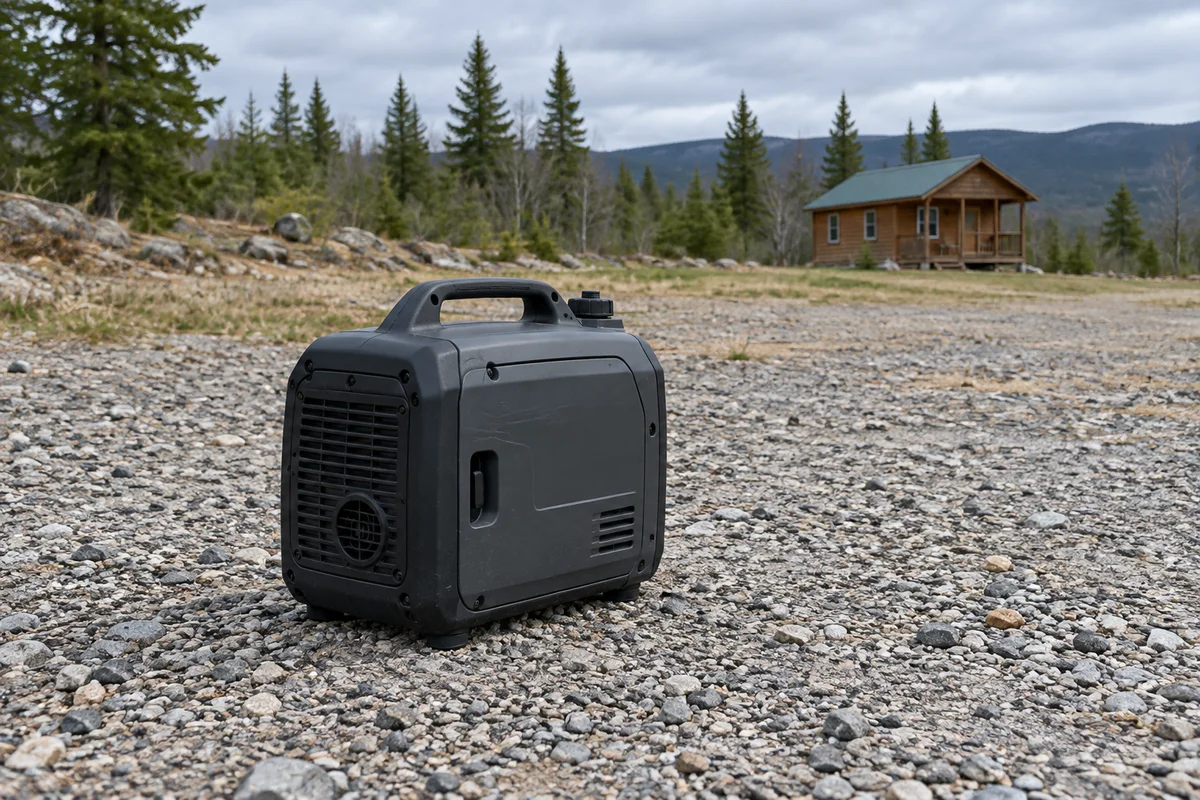
Compare continuous output
How much power can you keep using?
Running watts by fuel, on the same scale. Starting and peak ratings are not shown.
- Honda EU2200ITAN47.4 lb dry
Gasoline only · no propane operation
Manufacturer ratings for Honda EU2200ITAN — opens in a new tab - Champion Power Equipment 20118339 lb dryManufacturer ratings for Champion Power Equipment 201183 — opens in a new tab
- Westinghouse iGen5000DFc105.8 lb dryManufacturer ratings for Westinghouse iGen5000DFc — opens in a new tab
Manufacturer specifications, not our test results. More watts do not automatically mean a better fit: check charger input, startup demand, voltage and each outlet’s limit.
A backup generator earns its place when you can explain what it must keep running, how it will recharge your battery and where you can operate it safely. Start with those jobs. A large wattage printed on the case does not tell you whether a generator fits your charger, well pump or cabin routine.
For a short weekend, reducing consumption or bringing a charged battery may cover the gap. For repeated cloudy days, a planned generator session can restore energy when solar cannot. This guide compares three documented US 120V inverter models for that second situation. It is a specifications-based shortlist; we have not field-tested these generators or measured their fuel use.
First decide where it can operate
Choose the outdoor operating location before buying. The CPSC’s generator safety guidance calls for outdoor operation at least 20 feet from homes and buildings, with exhaust directed away from windows, doors and vents. Never run one in a cabin, garage, shed or enclosed space, even with doors open.
A built-in CO shutdown sensor is an additional safeguard. Keep working CO alarms with battery backup on each level and outside sleeping areas; a sensor on the generator does not replace them. If an alarm sounds, get everyone outside immediately and call emergency services.
The location also needs a dry operating arrangement allowed by the generator’s instructions, clear exhaust and cooling space, and a safe route for correctly rated outdoor cords. Do not solve bad weather by moving the generator inside or enclosing it in a homemade box. If the site cannot accommodate safe operation, choose another backup approach.
Size the running load and the starting load separately
Make a list of equipment that will run at the same time. Include the battery charger’s AC input, not just its DC output into the battery. Add the fridge, lights and any other direct AC loads. Then check each motor’s startup demand and how long the generator can sustain its maximum output.
Here is a hypothetical first pass:
- Battery charger: 800W AC input.
- Refrigerator while running: 150W.
- Lights and small electronics: 50W.
- Combined running demand: 1,000W.
Those are assumed numbers, not measurements of your appliances. If the refrigerator briefly needs an assumed 900W during starting instead of 150W, that moment becomes 1,750W with the other loads still connected. Real motors can differ considerably. Check the actual equipment and available generator headroom rather than using this example as a sizing promise.
The cabin energy audit helps identify the loads. Keep watts for simultaneous demand separate from watt-hours for the day's energy. Check voltage, frequency, outlet current limits and the charger’s specified current or VA as well; watts alone do not establish complete compatibility.
Three candidates at a glance
These are manufacturer ratings for the exact versions named below. All three provide 120V AC; none is a standalone 240V source for a well pump.
- Honda EU2200ITAN: gasoline; 1,800W rated, 2,200W maximum; recoil start.
- Champion 201183: gasoline or propane; 1,850W running on gasoline, 1,665W on propane; 2,500W starting; recoil start.
- Westinghouse iGen5000DFc, non-EFI: gasoline or propane; 3,900W running on gasoline, 3,500W on propane; 5,000W gasoline peak and 4,500W propane peak; electric, remote or recoil start.
A bigger model is useful only if the loads need it. It brings more equipment to transport and maintain, and cannot force a charger or battery to accept energy faster than their own limits. A remote-start button also does not make a portable generator an unattended automatic backup installation.
Honda EU2200ITAN: a modest gasoline-only setup
The Honda EU2200i, EU2200ITAN variant — opens Amazon US in a new tab is worth comparing when you want a movable source for selected essentials and a modest charging session. Its Honda specifications establish the ratings above, CO-MINDER shutdown and a dry weight of 47.4lb. This TAN version is listed by Honda as not for sale in California.
Choose around your actual load rather than the model’s reputation. It is not the option for someone requiring propane, electric starting or 240V output. Confirm how you will carry it, where it can be serviced and which serial-specific manual applies to the unit delivered.
Earlier EU2200i units were subject to CPSC recalls with specific serial ranges. Check the serial number and any required remedy, particularly for a used unit. A familiar model name or an updated retailer title does not settle recall status for an individual machine.
Champion 201183: smaller dual-fuel backup
The Champion 201183 — opens Amazon US in a new tab offers gasoline or propane operation in the smaller output class. The manufacturer’s model page lists CO Shield shutdown and a 39lb unit weight. Its propane running rating is lower than its gasoline rating, so plan using the fuel you actually intend to bring.
This is a candidate for a cabin where modest charging and selected appliances matter more than high simultaneous output. It needs recoil starting. A charger that already draws close to the generator’s fuel-specific running limit leaves little room for a fridge starting or another appliance being switched on.
The manufacturer lists an LPG hose among the supplied items, but the propane cylinder is separate. Verify the exact package. At the time of this review, the Amazon page for 201183 had no featured offer; check an actual seller and the exact model before treating it as an available purchase. Similar-looking Champion variants are not interchangeable specifications.
Westinghouse iGen5000DFc: more 120V capacity
The Westinghouse iGen5000DFc — opens Amazon US in a new tab is the larger candidate when a verified charger and other essential loads exceed the smaller models. The non-EFI manufacturer specifications list CO shutdown, wheeled transport and 105.8lb dry weight. Confirm the non-EFI model; the EFI version is a separate product.
Its higher total output does not mean every outlet can deliver that total. Match the charger’s plug and permitted input to the individual receptacle rating. The TT-30R outlet is 120V, not a 240V well-pump connection. Manufacturer specifications also mark this version non-CARB, so check delivery and destination suitability before ordering.
This model makes less sense if a smaller unit comfortably covers your planned session. Think through loading it into a vehicle, moving it over your ground, storing it securely and maintaining its starter battery between visits. The included starter-battery float charger is not a charger for your cabin battery bank.
Charge through the correct equipment
Use the battery system’s approved AC charger, an appropriately configured inverter-charger, or a power station’s supported AC charging input. A basic DC socket on a generator is not a universal charging solution. An inverter that only produces AC from a battery cannot automatically charge the battery in reverse.
Before connecting, check the charger’s accepted voltage and frequency, maximum AC input, adjustable input limit if offered, and compatibility with generator power. Separately check the battery’s chemistry, charging voltage, current and temperature limits. A large generator cannot make an unsuitable charger safe for a battery.
For a portable power station, follow its manufacturer’s generator-charging instructions and reduce the charging input if needed to leave headroom for other loads. For a fixed battery system, have its designer or installer confirm neutral, grounding, protection and changeover arrangements. Never alter a neutral bond or defeat protection to make a combination work.
Use the cabin battery guide to keep the storage decision separate from the source that replenishes it.
Estimate the charging session in energy
Suppose your battery needs another 2,000Wh, and the charger draws a constant 800W from the generator. With an assumed 85% conversion into stored energy, the battery gains 680Wh per hour. Dividing 2,000 by 680 gives about 2.9 hours.
That is an optimistic constant-power calculation, not measured performance or a fuel-runtime promise. Charging may slow as the battery fills. Battery temperature, charge limits and other loads can change the result. If cabin equipment is drawing from the same battery while charging, subtract its demand from the energy being added.
Compare the result with the time you can reasonably supervise a session and the generator’s maintenance requirements. Do not compare manufacturers’ headline runtime numbers without checking the load, fuel quantity and test conditions. A quarter-load fuel-runtime claim is not a promise for a heavy charging session.
Make the backup fit the solar plan
Use battery reserve and cloudy days to identify the deficit you are trying to cover. If solar regularly falls short, a generator can bridge the gap, but frequent running may point toward reducing consumption or revisiting the array and charging design.
The solar-kit selection guide covers that broader parts decision. Add the cost of fuel, engine servicing, cords, safe storage and any installation work when comparing alternatives. A cheaper purchase can still be inconvenient if it requires a fuel you rarely carry or service that is difficult to obtain.
Altitude can reduce available engine output. The Honda owner manual, for example, documents altitude-related changes and dealer work. Check the exact generator manual for your location rather than transferring one model’s adjustment instructions to another.
Before the first backup session
The CPSC portable-generator safety sheet warns against backfeeding a building through a wall outlet. Fixed wiring needs a qualified electrician and appropriate transfer or isolation equipment. Turning off a breaker is not a substitute for a properly designed connection.
Shut the generator down and let it cool before refueling. Keep fuel outside living areas in approved, labeled containers and away from ignition sources. Follow the model’s storage and servicing instructions between visits.
In your off-grid plan, record the exact generator candidate, intended fuel, charger input, simultaneous loads and safe operating location. Leave unresolved compatibility questions visible. Buy when those pieces form one workable system, then trial the complete setup before relying on it during an outage.
Equipment for this approach
Consider for your setup
Honda EU2200i — EU2200ITAN US gasoline inverter generator
A gasoline-only, 1,800W rated candidate for a modest charging session plus selected essentials. Check startup loads, serial-specific documentation and local availability.
A 120V gasoline inverter generator with 1,800W rated output, 2,200W maximum output, recoil start and CO-MINDER shutdown. The checked listing names EU2200ITAN.
- Gasoline running
- 1,800 W
- Fuel
- Gasoline
- Dry weight
- 47.4 lb
Suitable for: A small, movable backup source when the charger and essential appliances fit the rated output and starting-load limits.
Limits, compatibility & other parts
- Keep in mind
- Not a propane or 240V source. Honda lists this TAN variant as not for sale in California. Earlier EU2200i units had recalls; check the delivered serial number and completed remedies, especially on used equipment.
- Check compatibility
- Match 120V/60Hz loads and the charger’s AC input, including starting demand. Verify the exact TAN variant, serial-specific manual, altitude requirements and protective arrangements. CO-MINDER does not replace outdoor siting or indoor alarms.
- Other parts needed
- Fuel, specified engine oil, suitable outdoor cords and working cabin CO alarms are separate checks. Battery charging needs a compatible AC charger; fixed building wiring requires qualified installation.
Save this candidate to my plan
Product information checked 30 September 2026. Check current options and availability on Amazon.
Champion 201183 — 2500W dual-fuel inverter generator
A smaller dual-fuel option: calculate with 1,665W running when using propane. Confirm an actual seller for the exact 201183; the checked listing had no featured offer.
A recoil-start 120V dual-fuel inverter with 1,850W running output on gasoline or 1,665W on propane, and 2,500W starting output. Includes CO Shield shutdown.
- Gasoline running
- 1,850 W
- Fuel
- Gasoline / propane
- Dry weight
- 39 lb
Suitable for: Modest charger and essential-load requirements where choosing gasoline or propane matters more than electric starting or high continuous output.
Limits, compatibility & other parts
- Keep in mind
- Not a 2,500W continuous supply or a 240V generator. Propane reduces running capacity. The checked Amazon page had no featured offer; confirm an actual seller and exact model before planning a purchase.
- Check compatibility
- Size against the rating for the fuel used, the charger’s AC input and appliance startup loads. Follow the exact manual for altitude, weather protection, cords and grounding. CO Shield is an additional safeguard, not permission to operate near a cabin.
- Other parts needed
- Manufacturer lists an LPG hose, engine oil, funnel and USB adapter. A suitable propane cylinder is separate. Check package contents, outdoor cords, cabin CO alarms and the separate battery charger needed by your system.
Save this candidate to my plan
Product information checked 30 September 2026. Check current options and availability on Amazon.
Westinghouse iGen5000DFc — US dual-fuel inverter generator
Consider when verified 120V charging and appliance loads need more continuous output. Confirm individual outlet limits and transport; its higher rating does not increase a charger’s own limit.
The non-EFI iGen5000DFc: 3,900W running and 5,000W peak on gasoline, or 3,500W running and 4,500W peak on propane. A 120V unit with electric, remote and recoil starting.
- Gasoline running
- 3,900 W
- Fuel
- Gasoline / propane
- Dry weight
- 105.8 lb
Suitable for: A larger verified 120V load or charging requirement that exceeds the smaller candidates, where wheeled transport and extra weight are practical.
Limits, compatibility & other parts
- Keep in mind
- Not a 240V well-pump supply or automatic standby system. Do not substitute the EFI model’s specifications. A larger generator cannot exceed the charger, battery or individual outlet limits.
- Check compatibility
- Manufacturer lists 120V household and TT-30R outlets, CO shutdown and a floating neutral. Have building integration, grounding and protection reviewed for the installation. Confirm destination restrictions; manufacturer marks this version non-CARB.
- Other parts needed
- Manufacturer lists oil/funnel, remote, LPG regulator/hose and a starter-battery float charger. That small charger is not a cabin battery-bank charger. Plan fuel, outdoor cords, indoor CO alarms and a separate compatible cabin charger.
Save this candidate to my plan
Product information checked 30 September 2026. Check current options and availability on Amazon.
Sources & further reading
- CPSC’s generator safety guidance (opens in a new tab)
- Honda specifications (opens in a new tab)
- CPSC recalls with specific serial ranges (opens in a new tab)
- manufacturer’s model page (opens in a new tab)
- non-EFI manufacturer specifications (opens in a new tab)
- Honda owner manual (opens in a new tab)
- CPSC portable-generator safety sheet (opens in a new tab)