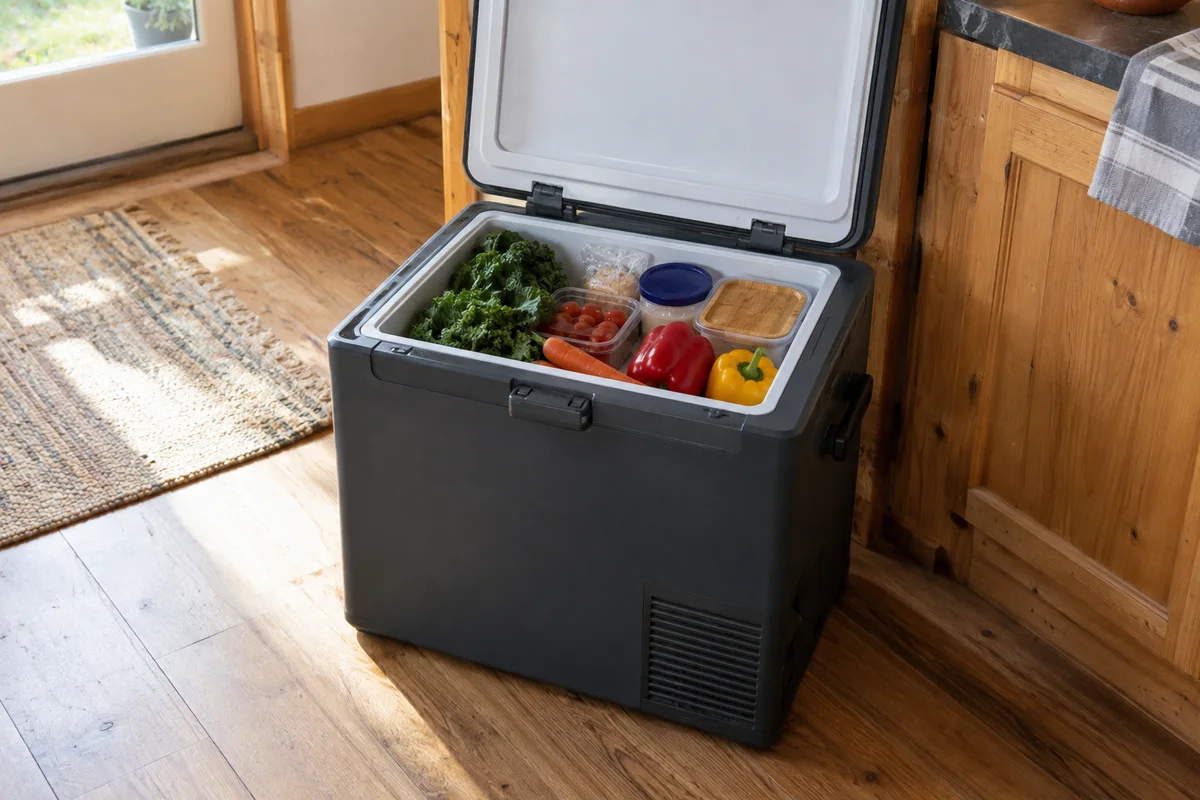
A 12V refrigerator can make cabin meals much easier, provided you can keep it supplied with power through the night and during poor weather. The right choice starts with your groceries, visit length and available energy. A larger fridge also needs more floor space, a suitable installation and a plan for what happens when you leave.
Before comparing models, write down three things: the food you need to keep cold, how long you stay, and whether refrigeration must continue between visits. Our kitchen and cold-storage guide helps with the first decision. Here we work through the equipment and power budget.
Decide whether you need a refrigerator yet
For a short visit, an insulated cooler with enough ice or frozen packs may meet your needs. Account for the space the ice occupies, where replacements will come from, and the trip home. Use a thermometer instead of judging performance by whether the contents feel cold.
FDA guidance puts refrigerator storage at 40°F or below and freezer storage at 0°F or below. It recommends an appliance thermometer to check the actual temperature. That applies to your food-storage plan even when the appliance's display looks reassuring. FDA refrigerator guidance.
A powered fridge becomes more appealing when ice runs interrupt longer stays, you regularly store perishables, or you want repeatable temperature control. A cooler remains a useful option while you establish the cabin's power supply. Neither choice excuses checking food temperature.
Choose the layout around real groceries
- Portable chest fridge: useful for carrying food between home, vehicle and cabin. Check loaded weight, baskets, lid clearance and reaching the bottom.
- Fixed upright fridge: useful for shelves and a permanent kitchen arrangement. Check installation approval, cabinet dimensions, door swing and ventilation.
- Insulated cooler: useful when visits are short and ice is practical. Check usable food space after adding ice and the replenishment routine.
Measure your usual containers, tall bottles and meal portions. A capacity figure in liters cannot tell you whether a particular casserole dish fits. Consider who will lift or reach into the unit, too. Mark its footprint on the floor and try the access with nearby cupboards open.
Check the temperature zones. A single-zone fridge/freezer lets you select a temperature for one controlled compartment. It does not provide independently controlled chilled and frozen sections at the same time. If you need both, investigate a genuine dual-zone unit or separate appliances and budget for their combined demand.
Watts tell you the load; watt-hours tell you the energy
A compressor runs as cooling is needed. Its power while operating is different from the energy used across a day. Multiplying a nameplate wattage by 24 hours assumes that load continues without interruption; it is not automatically a realistic daily consumption figure. ICECO describes its compressor switching off at the selected temperature and restarting as the compartment warms. ICECO operating explanation.
Look for Wh/day or kWh/day data with stated test conditions. If a manufacturer gives average current, check the voltage, temperature settings and measurement period. Compare figures taken under comparable conditions. A freezer setting and a refrigerator setting answer different questions.
For equipment you already own, measure a representative full day using a suitably rated meter at the supply you intend to use. A plug-in AC meter measures the AC route, including its adapter; it does not directly measure the DC route. Note cabin temperature, food loading and door openings alongside the result. Repeat during hotter conditions before relying on one mild day's reading.
Work through a two-night energy example
The figures below are hypothetical planning inputs, not measurements of the ICECO VL45 or another named fridge.
Assume a generic refrigerator consumes 400 Wh/day at its DC input, with another 100 Wh/day for lights and phone charging. For two days without charging:
(400 + 100) Wh/day × 2 days = 1,000 Wh delivered to the loads.
Now assume, solely for this example, that you plan to use 80% of nominal battery energy and that 90% of that reaches the loads after system losses:
1,000 ÷ (0.80 × 0.90) ≈ 1,389 Wh nominal battery energy.
Those percentages are assumptions to replace with your equipment's limits and observed performance. They are not universal battery settings. This calculation also excludes initial cooling of warm groceries and any demand beyond the stated loads.
If the refrigerator instead needs 600 Wh/day, the same assumptions produce roughly 1,944 Wh. That difference is why a daily energy estimate matters more than a claim that a battery can “run a fridge.” Add your own assumptions to the energy audit and cabin planner.
Give heat somewhere to go
Place the fridge where its ventilation openings stay clear, away from direct sun and nearby heat sources. Do not turn a portable chest fridge into a tightly enclosed built-in unit unless its instructions permit that installation. Leave the clearance required by the exact model.
Dometic's CFX3 manual calls for a ventilated location, clear vents and space for air circulation. It also recommends limiting unnecessary opening and avoiding needlessly low settings. These are reasons to assess the installation as well as the appliance. Its model-specific dimensions and limits are not interchangeable with ICECO's. Dometic CFX3 manual.
Ambient temperature belongs in your estimate. Dometic's energy guidance explicitly ties average consumption to both internal and ambient temperatures. Check the chosen fridge's stated operating range, including conditions in an unheated cabin; a summer specification does not settle winter suitability. Dometic energy guidance.
Check the entire electrical path
Confirm supply voltage, connector rating, cable length and fuse requirements. A power station's large AC-output number says little about the limit of its DC socket. Use the manufacturer-approved cable and have any permanent circuit sized for its actual route and load.
Voltage at the fridge can fall under load even when the battery appears healthy. ICECO's VL45 manual identifies wiring-related voltage drop during compressor startup as a possible cause of low-voltage protection trips. A shutdown therefore needs investigation of the supply and connections, not an automatic purchase of a bigger battery. Match protection settings to the battery system; don't simply keep lowering them to suppress a fault. ICECO VL45 manual.
One candidate to investigate: ICECO VL45
The ICECO VL45 is a 45-liter single-zone portable model supporting 12/24V DC and 110–240V AC operation. It can serve as a refrigerator or freezer. Those characteristics make it a candidate when you want portable cold storage with one temperature zone. Manufacturer specifications.
Our VL45 candidate — opens Amazon US in a new tab links to the Amazon US listing identified as the original 45-liter model without an insulated cover. Recheck the selected variant, seller and package before ordering: VL45, VL45ProS and VL45PLUS are different products. This guide does not establish current availability. We have not field-tested this model or established its daily consumption in your cabin conditions.
Choose it for further comparison only if its storage arrangement and installation fit. For regular frozen food alongside chilled groceries, start with a different configuration rather than expecting two independent temperatures from this one.
Solar adds a charging source; it does not remove the overnight requirement. Build the budget around storage, charging opportunities and a cloudy-weather margin using batteries, solar and cloudy days. Then decide whether to leave the fridge running between visits or take perishables home and clean it out.
Equipment for this approach
Consider for your setup
ICECO VL45 45-liter single-zone refrigerator
One original 45-liter single-zone candidate for readers who want portable cold storage. Assess its layout and supply requirements; the article’s energy example is hypothetical, not a measured VL45 result.
The original 45-liter VL45 is a portable single-zone refrigerator or freezer supporting 12/24 V DC and 110–240 V AC. The linked listing identifies the version without an insulated cover.
Suitable for: A candidate for portable cabin cold storage when one temperature zone, its physical layout and the measured power budget fit your needs.
Limits, compatibility & other parts
- Keep in mind
- Does not offer independently controlled chilled and frozen compartments together. We have not field-tested its noise, startup behavior or daily energy consumption in a cabin. Do not assume suitability for an unheated winter building.
- Check compatibility
- Check voltage at the appliance under load, socket and cable ratings, battery protection settings, ventilation and lid clearance. The original VL45 is distinct from VL45ProS and VL45PLUS. Use the current exact-model manual for installation.
- Other parts needed
- The manufacturer manual lists AC and DC cords and two baskets. Recheck the actual seller package; an insulated cover is not included in the identified variant. Use an appliance thermometer to check food temperature.
Save this candidate to my plan
Product information checked 18 September 2026. Check current options and availability on Amazon.