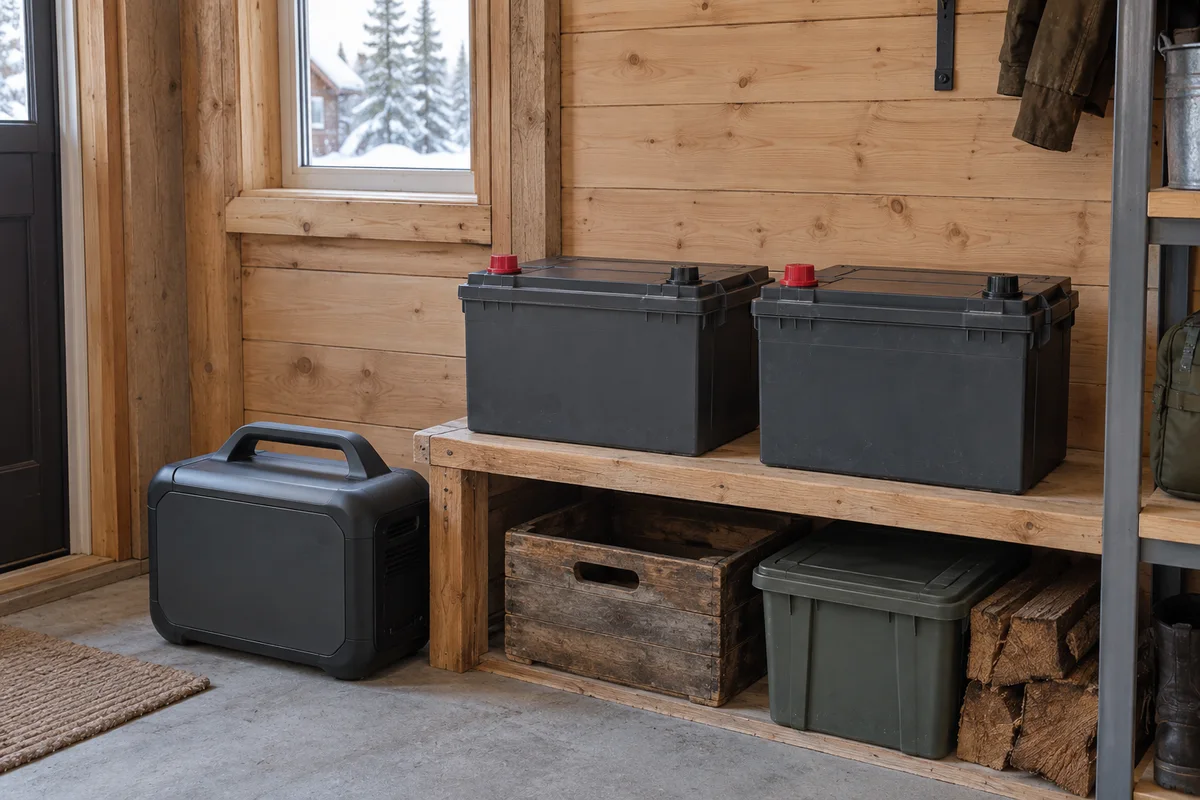
The battery decision starts with what happens between charges. A weekend of phone charging is different from leaving a refrigerator running until next Friday. A winter cabin adds another question: can the battery accept a charge when you return?
Choose the arrangement first, then compare an exact model. This guide considers three documented candidates: an integrated portable station, a separate battery with cold-charge cutoff and a separate self-heating battery. They are alternatives for different circumstances, not three parts to connect together. We have not field-tested these products.
Pick the situation closest to yours
- Short visits, with equipment carried home: start by comparing portable power stations. List the devices you plug in and decide where the station will recharge.
- A cabin with equipment that stays installed: compare a separate battery bank as part of a complete system. Include charging, protection, distribution and any inverter in the decision.
- A refrigerator or other load stays on while you are away: calculate the entire gap between reliable charges. A battery sized only for your two nights may be far too small.
- An unheated cabin in winter: check the cell-temperature limits and charging behavior before choosing a capacity. More stored energy does not make a frozen battery ready to recharge.
If you cannot yet list the loads, begin with the off-grid energy audit. You do not need to decide on a brand before you know what the battery has to support.
Portable station or separate bank?
A portable station puts storage and several power outputs in one enclosure. This can make a first visit easier: carry it in, connect suitable appliances directly, then take it home to recharge. The trade-off is that its output ports, charging inputs and supported expansion determine what you can add.
A separate battery is one component. It does not become a solar system when a panel is placed beside it. A working installation also needs compatible charging equipment, protected wiring and distribution, plus an inverter if you need AC appliances. Compare complete systems rather than the price of a bare battery against a station.
For this comparison, the EcoFlow DELTA 3 Plus — opens Amazon US in a new tab represents the integrated approach. Its US specification is 1,024 Wh nominal storage and 1,800 W total rated AC output. The manufacturer specifications distinguish the Plus from other DELTA 3 models. Our linked variant is the standalone station; panels are separate.
The LiTime Group 24 Smart Bluetooth — opens Amazon US in a new tab and LiTime Group 24 Smart Self-Heating — opens Amazon US in a new tab represent separate batteries. Each has 1,280 Wh nominal energy. That larger number does not include the equipment required to turn either battery into a complete cabin supply.
Compare watt-hours, then power
Watt-hours describe stored energy. Watts describe how quickly equipment uses it. Amp-hours need a voltage alongside them: 12.8 V multiplied by 100 Ah equals 1,280 Wh. A battery labelled 100 Ah at another voltage does not contain the same energy.
Nominal storage is not a promise that every watt-hour reaches your appliance. Your operating reserve, conversion losses, standby consumption, temperature and battery condition affect the result. Keep the calculation boundary consistent: either measure energy leaving the battery or measure appliance energy and account for losses, without counting the same loss twice.
Power limits are a separate check. A hypothetical 2,000 W AC load through an inverter at an assumed 90% efficiency would require about 174 A at 12.8 V: 2,000 divided by 0.9 divided by 12.8. That exceeds a 100 A continuous battery rating even before allowing for lower voltage or startup behavior. Buying a large inverter does not increase the battery's current limit.
Use an installer's design for a permanent system. This calculation explains a purchasing constraint; it is not a cable, fuse or wiring specification.
Three examples before choosing a capacity
These are hypothetical planning inputs, not measurements of the candidate products. To make the arithmetic visible, assume only 80% of nominal battery energy is allocated to the planned loads, with the rest reserved. This 80% assumption is a planning choice, not a manufacturer's required discharge limit. In these examples the daily figures are battery-side demand, already including the assumed system losses.
For a short visit, suppose lights, phones and a laptop require 250 Wh per day. Two days require 500 Wh. Dividing by 0.8 gives a nominal-capacity planning target of 625 Wh before any additional contingency. Both a suitably specified station and a separately built system might cover that energy target, but their output limits and recharge arrangements still matter.
Now suppose a refrigerator and the system's background consumption total 700 Wh per day. Three days without useful charging require 2,100 Wh; under the same reserve assumption, the nominal target becomes 2,625 Wh. One 1,024 Wh station or one 1,280 Wh battery would not meet it. If the gap is seven days, the same calculation reaches 6,125 Wh. Changing the time between charges matters more than a small difference between product capacities.
For winter use, suppose your essentials need 500 Wh per day for two days. The energy calculation gives 1,250 Wh nominal under the same assumption. A 1,280 Wh battery would leave very little room beyond that assumed reserve, and the calculation includes no heater consumption. The next question is whether a cold battery can recharge from the available source. Do not round that uncertainty away.
Replace these inputs with your own measurements. The refrigerator selection guide explains why a compressor's headline power is not its daily energy use. The cloudy-day guide follows storage and recovery across several days.
Cold cutoff and self-heating solve different problems
The non-heated Smart battery stops charging when its cells are too cold. That is useful protection, but the battery still needs to warm before charging can resume. The LiTime Smart manual lists a 0–50°C charging range, a cutoff below 0°C and recovery above 5°C. A sunny panel does not remove this restriction.
The heated variant adds a warming function. Its manufacturer specification makes the charging source part of the decision. The self-heating manual lists 10 A as the required minimum for heating, while a footnote says greater than 10 A. Plan for more than 10 A available and confirm the current revision rather than designing exactly at that boundary.
Heating also takes time and charging energy. A small panel that barely supports daytime loads may not provide enough spare input for warming and recovery. Check the complete charging window, including what happens when clouds interrupt it.
A portable station is not automatically a winter solution either. EcoFlow's regional DELTA 3 Plus manual gives charging at 0–45°C and discharge at −10–45°C. Its battery-pack protection rating should not be read as permission to leave the whole appliance exposed to weather.
Check what expansion really means
Decide the system voltage with the charging and output equipment, not by accumulating whichever batteries happen to be on sale. Manufacturer-permitted configurations are limits, not a complete design. The LiTime Smart product page and heated model page list up to four parallel strings of four batteries in series. Matching, balancing, protection and the exact revision still need checking.
Do not mix the two LiTime examples into a bank simply because both say 100 Ah. A future battery purchase should match the system's approved expansion requirements. If a substantially larger permanent system is likely, compare that design before buying several small batteries.
A portable station follows its own expansion rules. Approved extra batteries and cables are not equivalent to connecting arbitrary 12 V batteries. Check which ports are usable together and the limits of each charging input.
Budget the missing parts and the return visit
Ask for a complete list before comparing totals:
- Battery or station, plus any supported expansion needed for the actual stay.
- Charging source, compatible controller or charger, and any separate solar cable.
- Properly designed protection, disconnects, mounting and wiring for a separate bank.
- Inverter and distribution if your equipment needs AC power.
- A plan for temperature, storage between visits and recovery after an extended cloudy period.
The cabin solar-kit guide helps check whether a package includes those pieces. Avoid counting a controller twice when it is already integrated, or assuming a bundle includes a panel because its title says solar generator.
Before leaving, decide which loads remain on and how you will know if charging stops. A display that looked healthy on Sunday does not establish enough reserve for Friday. Record the longest expected gap between dependable charges, the load that must survive it and the next measurement in your off-grid plan.
Which candidate belongs on your shortlist?
Choose the integrated station path if carrying the equipment and plugging appliances directly into it fits your routine. Choose the separate Smart battery path when you have a designed system and a workable way to keep charging within its temperature limits. Consider the heated option when cold charging is part of the real use case and the source can support warming.
If none meets the energy, current or temperature requirements, keep looking rather than stretching the scenario to fit a product. The equipment notes below record the exact variants, fit and limitations. Check the selected Amazon variant again before purchase: a multipack, non-heated battery, different DELTA model or panel bundle changes the comparison.
Give stored energy a recovery plan
A larger battery extends the reserve but still needs recharging. Use the backup-generator selection guide to check the AC charger, battery charge limits and essential loads running at the same time. Its worked example separates generator output from energy actually reaching storage; it does not assume any generator can charge any battery directly.
Equipment for this approach
Consider for your setup
EcoFlow DELTA 3 Plus portable power station — US standalone
An integrated option for small plug-in loads and short stays; check usable energy and a realistic charging opportunity before choosing it.
A standalone US portable power station with 1,024 Wh nominal storage and 1,800 W rated AC output. The linked variant is the DELTA 3 Plus unit, not a solar-panel or extra-battery bundle.
Suitable for: A movable supply for cabin loads whose combined power and daily energy fit its limits, with a planned way to recharge between uses.
Limits, compatibility & other parts
- Keep in mind
- Not a complete cabin solar installation. Nominal capacity is not delivered energy, and X-Boost is not continuous rated output. No measured cabin runtime or ability to power all heating and cooking is claimed.
- Check compatibility
- Check the US output, appliance startup demand, solar input limits and cold-weather operating conditions in the exact manual. Panel voltage and current must fit the input; panel wattage alone is insufficient.
- Other parts needed
- For solar use, verify the panels, compatible charging cable and mounting needed. Confirm the actual package and supported expansion batteries; a separate component-system battery is not automatically a compatible extra battery.
Save this candidate to my plan
Product information checked 18 September 2026. Check current options and availability on Amazon.
LiTime Group 24 Bluetooth 12.8 V 100 Ah battery — one pack
A separate battery for a designed system where cold cutoff is sufficient and the cells can warm before charging.
A non-heated LiFePO4 storage battery with 1,280 Wh nominal energy and low-temperature charge cutoff. The identified listing is one Group 24 Bluetooth 100 Ah battery.
Suitable for: A storage component for a designed cabin system with suitable charging, protection and a plan for battery temperature.
Limits, compatibility & other parts
- Keep in mind
- Not a portable power station or a self-heating battery. Cold-charge cutoff stops charging; it does not warm the battery. No claim is made that one battery covers the guide’s two-day example.
- Check compatibility
- The manufacturer specifies charging at 0–50°C and a 100 A continuous discharge limit. Match charger settings, load and startup current, terminals and protection. Check current matching-battery rules before series or parallel expansion.
- Other parts needed
- A compatible charger or solar controller, correctly selected cables, fuse, disconnect and protected mounting are separate system decisions. Add a suitable inverter only if AC loads are needed. Confirm dimensions before choosing an enclosure.
Save this candidate to my plan
Product information checked 18 September 2026. Check current options and availability on Amazon.
LiTime 12V 100Ah Group 24 Smart Self-Heating — single battery
A separate heated option when the charger can supply the heating requirement; reserve alone does not solve winter recharging.
A separate 12.8 V, 100 Ah LiFePO4 battery with 1,280 Wh nominal energy, Bluetooth, a 100 A BMS and self-heating. The identified listing is one Group 24 heating battery, not a multipack.
Suitable for: A separately designed cabin system where cold charging is expected and the charging source can meet the heater's input requirement.
Limits, compatibility & other parts
- Keep in mind
- Not a complete winter-power solution or permission to charge frozen cells directly. We have not measured its heating time or cold-weather runtime.
- Check compatibility
- The manual lists 10 A minimum for heating but its footnote says greater than 10 A; plan for more than 10 A available and confirm the current revision. Charging follows cell warming. The manufacturer lists up to 4P4S with matched compatible batteries; don't mix the heated and non-heated candidates into one bank.
- Other parts needed
- Needs compatible charging equipment, protected wiring, disconnects, secure mounting and an inverter for AC loads. Budget charging energy and time for heating before replenishing the battery.
Save this candidate to my plan
Product information checked 25 September 2026. Check current options and availability on Amazon.