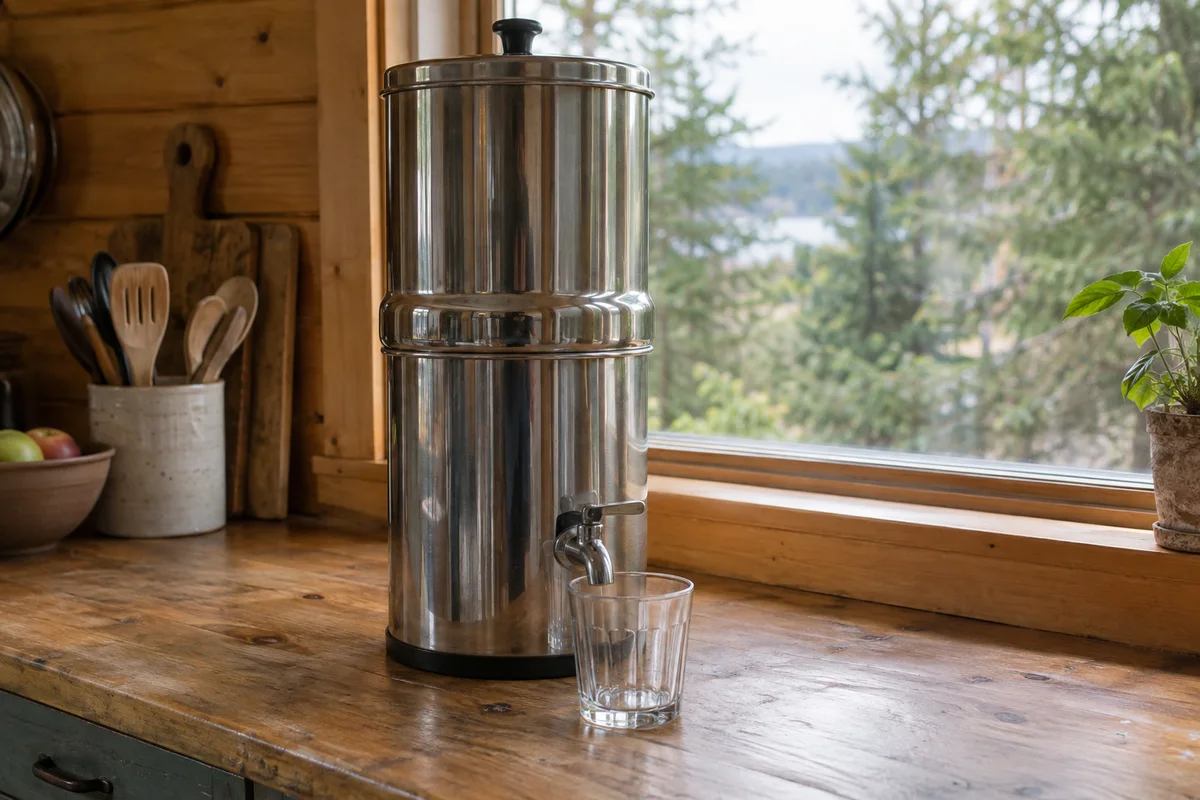
A countertop filter looks like a simple cabin purchase: fill it, wait, and pour a glass. The harder question is whether it addresses what is actually in your water.
Start with the source and a specific treatment need. Then compare equipment that can meet it, including the work required between visits. This guide helps you prepare that buying brief. The public-health references use a US context; ask your local water or health authority which testing and treatment requirements apply at your place.
Start with the water you will actually use
For a public water supply, begin with the utility’s annual water-quality report. Treatment may be unnecessary when the water has no harmful germs or chemicals. A filter bought for taste has a different job from one needed to address a health concern. CDC: choosing home water filters.
If you carry that water to the cabin, describe the complete route: filling point, transport container, storage and outlet. Put handling questions alongside the source report rather than assuming the report answers them.
For a private well, EPA recommends annual testing for total coliform bacteria, nitrates, total dissolved solids and pH, with additional tests for suspected contaminants. Use a certified drinking-water laboratory. Repairs, significant nearby changes and changes in water quality can call for immediate retesting. Discuss the test panel with the local health department; a basic result is not a check for everything. EPA: protecting your home’s water.
Collected rainwater needs its own assessment. Germs and chemicals can enter from the air, catchment and collection materials. CDC advises regular testing when using it for drinking, cooking or bathing, and keeping it separate from safe piped water. Where available, CDC favors public-system or bottled water for drinking and cooking. CDC: rainwater and health.
Keep roof area, tank volume and seasonal supply in your rainwater planning notes. This buying decision needs a separate answer: what must the treatment address?
Give every treatment claim a specific job
Make three headings in your notes: particles, germs and dissolved contaminants. Under each, record the concern, its evidence and who will interpret the result. Leave an unknown clearly marked.
Appearance cannot establish safety. Many ordinary pitcher and refrigerator filters are not designed to remove germs. Filters that address germs may leave chemicals behind, and the reverse is also possible. CDC filter guidance.
Keep parasite, bacteria and virus claims separate when comparing candidates. Also distinguish an absolute pore rating from a nominal or average one; they describe different limits. A general micron number is not a substitute for the particular performance claim you need. CDC: pore size and germ removal.
Ask a supplier to connect every proposed treatment stage to an identified need. “This catches debris before the next stage” is a useful explanation. “This makes any water safe” leaves too much unanswered.
Read beyond the certification badge
A standard number is a starting point. NSF explains that certification does not mean a system reduces every possible contaminant. NSF/ANSI 42 covers aesthetic reductions, such as taste and odor; 53 covers particular health-related reductions; 58 concerns reverse-osmosis systems. Check the exact reduction listed for the exact product. NSF: water-treatment standards.
Record the complete system model and replacement cartridge, then find the claimed certification through the certifier’s own directory. Compare that entry with the current manual and performance sheet. Save the evidence with its date so a later cartridge substitution can be checked against the same requirement.
Do not treat a retailer’s “tested to” statement or a component badge as proof that the complete system has the certification you are seeking. Ask for the actual listing and resolve any model mismatch before relying on the claim.
UV equipment needs equally careful reading. NSF/ANSI 55 distinguishes Class A treatment from Class B treatment, which concerns non-disease-causing bacteria in already disinfected water. The classes are not interchangeable approvals for an untreated source. NSF standards overview.
Choose the format after the treatment requirement
A gravity unit may suit someone who wants to refill a container by hand. An installed system may better fit a tap used throughout the day. Neither format tells you, by itself, which contaminants the equipment addresses.
Compare the routine as carefully as the dimensions. Where will you fill a gravity unit? Can everyone lift the filled container? Is there room to refill it without moving it? How long can you wait for the required volume, and where will you keep the instructions and replacement parts?
For an installed candidate, ask about required pressure, flow, pretreatment, power and service access. If considering reverse osmosis, ask for its feed-water requirements and how rejected water must be handled. For UV, ask for the water-quality prerequisites, maintenance schedule and behavior during a power interruption. Obtain these answers for the exact model rather than transferring them from another product.
Decide which outlets need treatment. A kitchen drinking-water arrangement and a whole-cabin system answer different needs. Bring that scope to the person assessing the source, particularly if a concern could affect uses beyond drinking.
Work through a fictional comparison
Imagine two people preparing for two nights at a cabin. They expect to bring their drinking and cooking water from an established supply while they investigate a rainwater system. They want convenient pouring at the kitchen counter and are considering a gravity filter.
Their first comparison is between bringing suitable water in a practical dispensing arrangement and adding a filter. They have not established a contaminant that needs removal. The purchase question is still open; a water filter should not become an automatic item simply because the cabin is off-grid.
Now imagine they want to switch to collected rainwater. Their notes must change. The convenience comparison cannot answer the new source-water question. They need an appropriate assessment and treatment specification before deciding whether either shortlisted filter belongs in the arrangement.
They could use this worksheet:
- Supply and outlet: collected rainwater for kitchen drinking and cooking. Next: describe the catchment, tank and route to the outlet for assessment.
- Contaminants requiring treatment: not established. Next: arrange appropriate tests and interpretation.
- Performance to verify: awaiting assessment. Next: record specific reductions and operating conditions.
- Output needed: not measured. Next: complete a use log and compare it with rated output.
- Equipment support: candidate not selected. Next: check power, pressure, space and service requirements.
- Between visits: the cabin may be unheated. Next: obtain a model-specific storage and freeze plan.
This is a fictional decision exercise, not evidence that the imagined rainwater is suitable for drinking. Its useful result is a short list of missing answers. Use the cabin water budget for the volume log, keeping treated drinking/cooking demand distinct from other uses.
Check the empty weeks before buying
Ask for the replacement schedule, cleaning instructions and storage procedure before choosing a model. Make sure someone can complete them within the actual visit pattern. CDC stresses following manufacturer maintenance and filter-replacement recommendations. CDC maintenance guidance.
Freezing deserves a specific answer. For its standard filters, Sawyer recommends replacement if freezing is suspected after initial wetting, because damage cannot be reliably judged by the owner. Its support guidance also calls for backwashing around prolonged storage and return to use. These are manufacturer-specific examples, not instructions for every cartridge or treatment system. Sawyer filter support.
Before checkout, ask what must be drained, removed, protected or replaced for your chosen equipment. Find out how it is returned to service after an absence. Keep the procedure in your arrival and leaving checklist, with the correct manual and replacement-part code.
Take a complete brief to the supplier
You are ready for a meaningful comparison when you can provide the source assessment, intended uses, required treatment claims, daily output needs and cabin operating conditions. Ask each supplier to identify the exact system, compatible consumables, installation needs and ongoing work against that same brief.
Keep unanswered requirements visible beside the quote. A useful filter purchase has a clear job, evidence that supports it and a maintenance routine you can carry out.