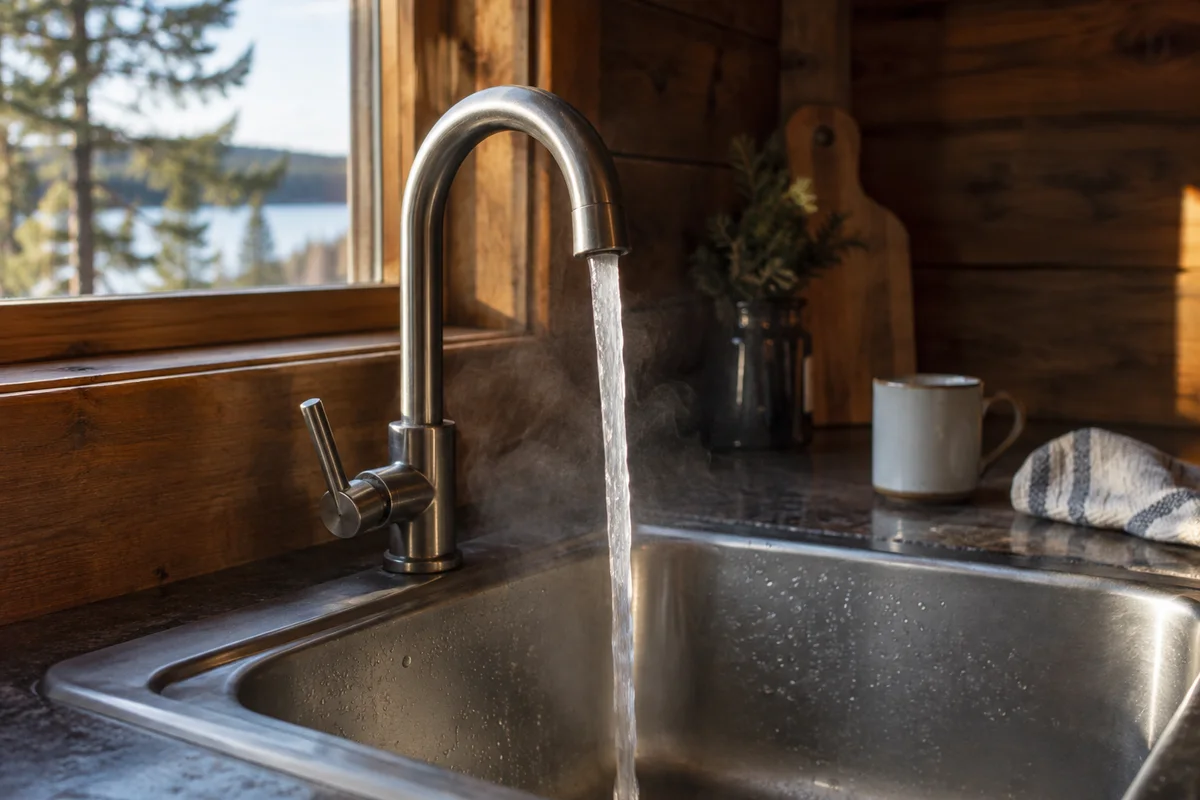
Choose a cabin water heater around the hot water you need and the services that can support it. Washing dishes after dinner, taking consecutive showers and arriving at an unheated building create different demands. A product described as “off-grid” has not answered those questions for you.
Start with a short description of your stay, the water supply and the intended installation location. Then compare heating methods. This guide helps prepare that decision and an installation brief; it does not specify gas connections, venting or electrical work.
Describe the hot-water routine
List where you want hot water, how often each fixture is used and what might run simultaneously. Include the busiest ordinary visit, rather than planning only around one person using a sink. Record which activities could comfortably happen at different times.
Separate these questions:
- How much hot water will you use across a day?
- How quickly must the heater supply it during one activity?
- Can you wait for stored water to reheat between uses?
- Must the system be ready immediately after arrival?
- What happens when the water, electricity or fuel supply is interrupted?
Keep these notes beside your cabin water budget. Hot water still needs a suitable source, replenishment and wastewater arrangement. The heater is one part of that system.
Compare three approaches
An electric storage heater holds heated water for later use. A small point-of-use tank is worth investigating when the task is limited, such as supplying a sink. Check the stored volume, recovery behavior and electrical demand together. Bosch's mini-tank FAQ explains that available hot-water duration depends on tank size and fixture flow, while recovery varies with incoming water temperature and the selected setting. Bosch electric water-heater FAQ.
For a concrete documentation example, the US Bosch Tronic 3000T ES4 manual lists 4.0 gallons and 1,440 W at 120 VAC. Those are storage capacity and heating power, not a shower-duration promise. We have not tested this model or established that it fits your cabin. Bosch ES4 manual, technical data.
Electric tankless equipment heats water as it passes through. Check whether the electrical system can support the required output while other equipment is operating. A small wall-mounted case does not establish a small electrical requirement. Fuel-fired equipment needs a suitable fuel supply and assessment of combustion air and exhaust arrangements. DOE's engineering guide identifies these supply checks separately from the water-heater selection. DOE tankless-water-heater guide, sections 3 and 4.
Compare these options against your routine before pricing a model. For each, ask what needs to be ready on arrival, who maintains it, and what you must do before leaving. A familiar operating routine can matter as much as a compact appliance.
Separate the power requirement from the energy budget
An inverter's output limit and the energy available from a battery answer different questions. Put the heater's documented electrical requirements beside the other equipment that might run at the same time. Then estimate how long heating actually operates. Our energy-audit guide helps keep those columns separate.
Here is a deliberately assumed calculation using a 1,440 W heating load. Suppose it operates for exactly 15 minutes:
Electrical energy: 1.44 kW × 0.25 hours = 0.36 kWh.
At an assumed inverter efficiency of 90%, the corresponding battery draw would be:
Battery energy: 0.36 kWh ÷ 0.90 = 0.40 kWh, before other loads.
The 15-minute duration and efficiency are hypothetical. This is not an ES4 recovery test, a quantity of delivered hot water or a battery-runtime estimate. Actual heater operation, losses and other cabin demands must replace the assumptions before choosing storage or charging equipment.
Read flow together with temperature rise
A tankless heater's useful output depends on both water flow and the required temperature increase. Temperature rise means the difference between inlet and outlet water temperature. DOE recommends comparing the maximum simultaneous demand with the required rise, using manufacturer performance information. Colder incoming water changes that requirement. DOE sizing guidance, section 2.1.
Ask the supplier to identify the point on the exact model's performance chart that matches your intended use. Record the inlet condition behind that answer. If you only know summer conditions, keep winter performance unresolved rather than copying the same result into both seasons.
Do not treat the largest gallons-per-minute figure on a listing as a guaranteed flow at every temperature. A useful quote should say which demand and conditions it covers, and what happens when another fixture is opened.
Check the water supply while it is being used
A pump's label alone does not establish that a heater will operate consistently. Give the installer the pump model, source arrangement and intended fixtures. Ask them to check delivery through the complete system, including the heater, rather than comparing isolated headline numbers.
For example, the Eccotemp L5 manual describes water-controlled ignition and an operating pressure range. That makes the water supply a compatibility question even though the appliance's heat comes from fuel. This example does not establish that a gravity supply or a particular cabin pump will work. Eccotemp L5 manual.
Water suitability also needs attention. Bosch's ES4 manual calls for suitable supply-water chemistry and professional assessment where treatment is necessary. Heating equipment does not establish that the source is safe to drink. Bosch water-chemistry requirements, section 3.1.
Settle the installation location before buying
Outdoor portable equipment and equipment intended for an indoor installation are different choices. The L5 manual expressly excludes indoor, confined-space and permanent installation. It describes taking the portable appliance down and storing it after use. It is therefore not a candidate for a permanently installed indoor cabin heater. Eccotemp location and use restrictions.
For an indoor system, have the qualified installer confirm that the exact model is intended for the proposed application and can meet its installation requirements. Resolve that before cabinetry or other work fixes the location. This guide provides no improvised enclosure, flue or gas-conversion instructions.
Include room for inspection and servicing in the layout. Ask how a leak, a required service visit or eventual replacement would be handled. A heater that fits into a space may still be difficult to maintain there.
Plan for freezing weather and empty weeks
The L5 manual includes a below-freezing operating restriction and directs users to its draining and storage procedure. Do not treat a portable summer setup as winter-ready or assume switching an appliance off protects it from freezing. Eccotemp seasonal limits and storage instructions.
For the system you actually choose, obtain an arrival and shutdown routine covering the appliance and connected water services. Ask what remains dependent on power when nobody is there and what happens during an interruption. Identify who can respond instead of assuming remote monitoring resolves the problem.
Keep that routine with your arrival and leaving checklist. If you plan to extend visits into colder months, review it alongside the seasonal comfort guide before changing the cabin's use.
Compare the complete purchase
Request a quote that separates the appliance from everything needed to operate and maintain it:
- Exact model, regional version and intended installation location.
- Verified water delivery and any required supply-water treatment.
- Appropriate energy supply and the other loads sharing it.
- Installer-specified connections, mounting, protection and controls.
- Commissioning, user instructions and the shutdown routine.
- Service access, consumables, replacement parts and ongoing costs.
Check recalls by exact identity too. CPSC's 2024 Camplux notice covers specified models and manufacture dates because of a regulator-connection fire hazard. It instructs affected owners to stop use and obtain the remedy. That is not a finding about every current Camplux heater. CPSC recall 24-137.
Add the full quote to your phased project budget. Your next step should be a clear answer to the largest remaining question: the hot-water routine, suitable location, supply capacity or seasonal shutdown. Resolve that before turning a promising product into a purchase.