A full water tank is useful. A tap that delivers a comfortable flow makes the cabin easier to live in. The pump between them needs to match the route the water travels, the fixtures you use and the power available.
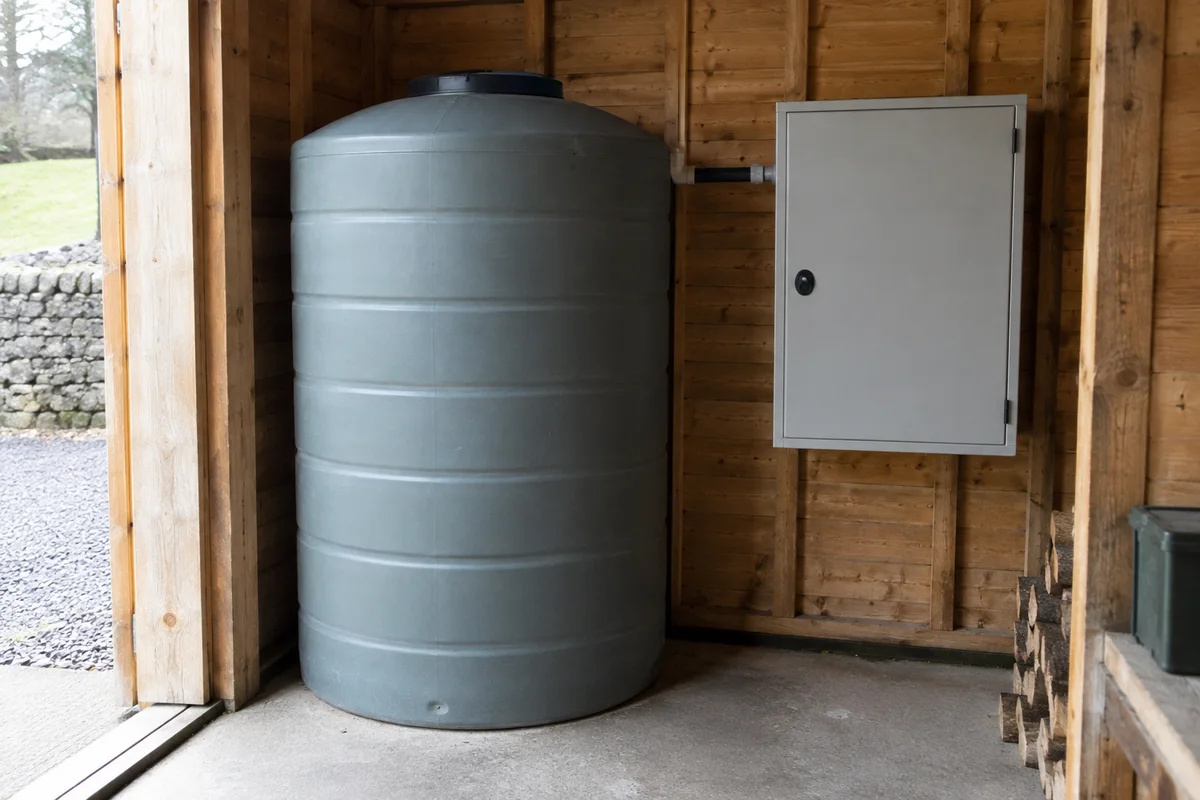
For this guide, the starting point is a nearby storage tank feeding a small cabin. If you are drawing directly from a deep well, begin with a well-pump assessment instead. A storage reservoir can separate those jobs: one pump replenishes the reservoir, while another supplies the building. Penn State Extension explains this arrangement.
Before comparing products, sketch your tank, pump location, sink, shower and any water heater. Mark distances and heights. That drawing will tell you more about a suitable pump than the number of people the listing says it serves.
Describe the busiest minute
Your daily water allowance helps size storage. Pump selection also needs the flow you expect at the same time.
Suppose your chosen shower needs 1.2 gallons per minute and you want another 0.5 gallons per minute at the kitchen sink. The simultaneous requirement is 1.7 gallons per minute. Those are illustrative inputs, not recommended fixture settings: use the specifications of the actual fittings you intend to install.
Decide whether simultaneous use matters. A couple who can wait until the shower finishes may accept a smaller setup. A shared cabin with several occupants needs a different conversation.
Make a short shopping brief:
- Which fixtures may run together?
- What flow and pressure does each require?
- Does the water heater have a minimum operating flow?
- How long is the longest expected run?
- Will anything draw water while the cabin is empty?
Keep your daily totals in the cabin water budget. Keep these peak-demand questions beside the pump shortlist.
Read flow and pressure together
A pump's headline flow and maximum pressure usually describe different operating conditions. You need the manufacturer's performance table or curve.
Take the Pentair SHURFLO Revolution 4008-101-E65 as an example. Its technical sheet gives typical performance at 12 V of 3 gallons per minute at zero pressure, but 1.5 gallons per minute at 30 PSI. Its pressure-switch shutoff is 55 PSI. Calling it a “3 GPM pump at 55 PSI” would give the wrong expectation. Pentair technical sheet.
The illustrative 1.7-GPM combined demand above therefore cannot be assumed available at 30 PSI from this model. That is a useful reason to check the curve before buying.
Pressure must also survive the route to the fixture. Raising water uses part of the available head; pipework, fittings and treatment equipment create further losses while water flows. A tank's changing water level can alter the conditions at the pump inlet. These are system questions, not just pump specifications. DOE pump-selection guidance.
Ask the supplier or installer to check the operating point using your layout, desired flow and required pressure at the fixture. A pump close to the tank on the same level faces a different job from one pulling uphill through a long inlet hose.
Check the job behind the label
The 4008-101-E65 is a 12 V DC freshwater diaphragm pump with an intermittent-duty motor. Its data sheet lists a six-foot dry-prime capability. That figure is not permission to put the pump anywhere within six feet of elevation and ignore inlet restrictions. Pentair technical sheet.
For a tank-fed cabin, it is a candidate to assess for short periods of fixture use. It should not become the default choice for hours of irrigation or continuous treatment simply because its voltage matches the battery. Pentair specifically excludes using this model to run a reverse-osmosis filtration system. Installation manual.
We have not field-tested this pump. Our assessment here is based on its documentation, with cabin suitability still dependent on the installation.
The SHURFLO 4008-101-E65 — opens Amazon US in a new tab is one model to investigate. Check the exact model, seller and included parts on Amazon before ordering; this guide does not establish current availability.
Buy the parts this pump actually needs
An accessory bundle is only helpful when it matches the pump.
For the 4008, Pentair requires an adequate 50-mesh inlet strainer. The manual also calls for flexible hose at the pump connections and accessible mounting for maintenance. It says an accumulator is not needed with this bypass design. Do not automatically add one because it appears beside the pump in a shopping recommendation. Installation manual.
The strainer's job is protecting the pump from debris. Drinking-water safety needs its own assessment. For rainwater, CDC recommends testing and choosing treatment that addresses the contaminants present. Clear-looking water is not evidence that it is safe. CDC rainwater guidance.
Before checking out, reconcile the pump, fittings, hoses and strainer against the installation manual. Record which items are supplied and which need buying separately. Keep the treatment equipment in that review too: its required flow and pressure must fit the complete system.
Put runtime into the power plan
Daily energy depends on how long the motor runs, not how long the pump remains installed.
Here is a deliberately fictional estimate: a pump drawing 60 W for 15 minutes uses:
60 W × 0.25 hours = 15 Wh
An hour at the same draw would use 60 Wh. This is arithmetic for planning, not a measured consumption claim for the SHURFLO. Actual draw and runtime need checking under your operating conditions.
Separate three questions in the energy audit: daily energy, instantaneous electrical demand and supply compatibility. A modest daily Wh total does not establish that a power station's DC socket, cable or protection is suitable.
Have the circuit selected for the actual pump and cable run using its manual. “12 V” on both labels is only the beginning of that check.
Make maintenance part of the layout
Picture cleaning the strainer after muddy boots, bedding and food boxes have filled the cabin. Can you reach it? Can you remove the pump without dismantling a cabinet? Where would a small leak become visible?
Ask for a maintenance plan with the installation. Pentair's manual covers sanitizing and winterizing as well as mounting; a seasonal cabin needs those procedures planned before the first freeze. For this pump, Pentair also instructs owners to switch the power off when leaving it unattended. Installation manual.
Add the relevant steps to your arrival and leaving checklist. Record the model, manual location, fittings and spare strainer details where the next visitor can find them.
You are ready to shortlist when you can describe the water source, peak fixture demand, plumbing route, power supply and expected run pattern. Use those facts to ask, “Will this pump deliver this flow at my required pressure?” That is a purchase question a supplier can answer.
Equipment for this approach
Consider for your setup
Pentair SHURFLO Revolution 4008-101-E65
The worked example uses this intermittent 12 V pump to show why flow at your operating pressure matters more than headline GPM. Compare your layout and simultaneous demand before choosing it.
A 12 V freshwater diaphragm pump for intermittent demand. Manufacturer typical performance is 3 GPM at zero pressure and 1.5 GPM at 30 PSI; 55 PSI is the shutoff setting.
Suitable for: A candidate for supplying a small cabin from a nearby storage tank when the required flow, pressure and intermittent operating pattern fit the pump curve.
Limits, compatibility & other parts
- Keep in mind
- Not a deep-well pump, drinking-water treatment device, continuous irrigation pump or pump for a reverse-osmosis system. Cabin suitability depends on the installation; we have not field-tested this model.
- Check compatibility
- Check the complete hydraulic route and 12 V supply. Ports are 1/2-inch-14 NPSM male. Use the specified fittings, flexible high-pressure hose, correctly sized wiring and electrical protection; switch pump power off when leaving unattended.
- Other parts needed
- An adequate 50-mesh inlet strainer, matching fittings and drinking-water-rated plumbing are required. Verify which parts the seller supplies. The manufacturer says this bypass pump does not need an accumulator.
Save this candidate to my plan
Product information checked 18 September 2026. Check current options and availability on Amazon.