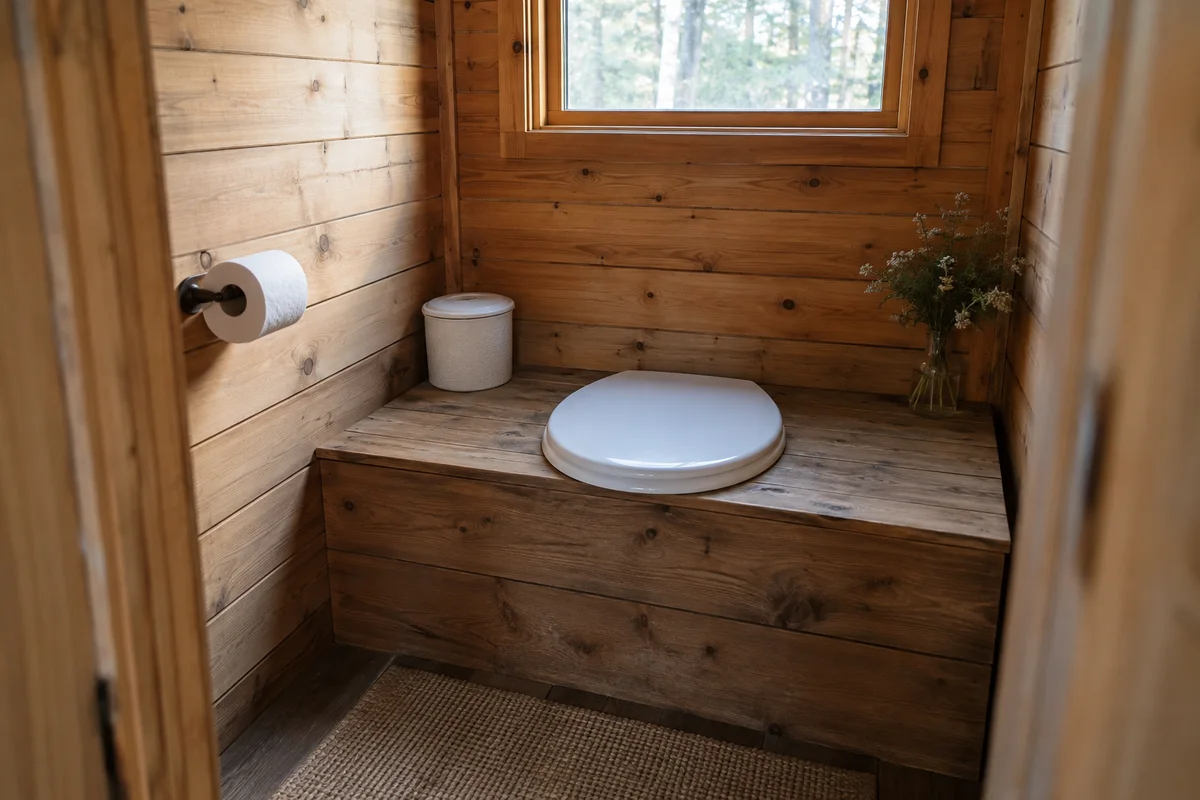
A waterless toilet can make a cabin usable without a conventional flushing toilet. The best fit depends on what happens after someone uses it: where liquids go, who empties solids, how ventilation stays powered and what you do before leaving for winter.
Start with those routines before choosing a brand. A toilet you can service comfortably every visit may suit you better than one advertised with a longer emptying interval. Our general off-grid toilet guide covers the broader sanitation decision. This guide compares two compact waterless designs for a cabin used intermittently.
Understand what the toilet actually does
“Composting toilet” appears on products with different operating methods. Some separate urine and mix solids with a moisture-absorbing medium. Others collect separated solids without mixing, relying on ventilation and subsequent handling elsewhere. Both leave material that someone must manage.
Separation, drying and finished composting are different stages. Removing a container does not establish that its contents are sanitized or suitable for growing food. Separett explicitly states that solids emptied from the Tiny have not yet become compost. EPA's composting-toilet fact sheet also identifies health concerns when inadequately treated material is used on soil. Separett product explanation; EPA background fact sheet.
Treat the disposal route as part of the purchase. A product label, a dry appearance or a lack of smell is not proof of safe treatment. This guide does not provide a home sanitation timetable or endorse spreading the contents on land.
Plan for your busiest visit
Write down the normal number of occupants and the largest group likely to stay. Then consider the longest interval before somebody can service the toilet. Two people visiting on weekends create a different workload from a family staying through a holiday, even if the annual number of nights is similar.
Make the routine concrete:
- Who will check and empty the liquids container?
- Can that person lift, cap and carry a full container without awkward bending?
- Where will it be emptied, and is that location available when you leave?
- Where will closed replacement containers and cleaning supplies be stored?
- Can guests follow the instructions without a demonstration every time?
Do not turn an advertised number of uses into a guaranteed number of weeks. Liquids and solids reach their limits separately. Record your own servicing pattern after installation, and keep checking the containers rather than waiting for a calendar reminder.
Two candidates with different servicing routines
These are conditional examples based on manufacturer documentation. We have not field-tested either toilet.
- Both designs collect liquids in a removable internal container, which needs its own emptying routine.
- Nature's Head uses a manual agitator and specified composting medium; Tiny collects solids without a mixing crank.
- Nature's Head uses a 12V fan with a separate AC adapter option; Tiny supports 12V operation or its supplied mains adapter.
- Check whether everyone can operate the Nature's Head handle and service its base, or remove Tiny's containers and maintain its ventilation routine.
Nature's Head standard with Spider Handle
The current manufacturer's standard product offers a hand-operated Spider Handle or a Foot Spider Handle. This comparison concerns the hand-operated Spider version with its internal urine bottle, not the Weekender or an externally drained model. The manufacturer identifies the standard family as NH-Standard-Toilet. Nature's Head product options.
This design is worth investigating if you accept mixing the solids chamber and replenishing the specified medium. Nature's Head describes urine separation, a drying medium such as coco coir, and fan-assisted airflow. Emptying also involves releasing components and moving the base, so watch the manufacturer's servicing demonstration before building a tight enclosure around it. Nature's Head use and servicing overview.
See the Nature's Head Spider Handle equipment details — opens Amazon US in a new tab for this candidate. Confirm the current seller, handle option and included package before ordering. Do not assume that a manufacturer's cabin installation kit is included in a standalone marketplace listing.
Separett Tiny with urine container, 1270-03
The Tiny 1270-03 collects liquids internally and uses a separate solids container without a mixing crank. It differs from the 1271 urine-tube model. This can suit someone who prefers removing containers to operating an agitator, provided the ventilation and emptying arrangements work for the cabin. Separett Tiny 1270-03.
Follow Tiny-specific consumable instructions. Separett advises against adding the loose bulking materials used in some other toilet designs, because they consume capacity and can interfere with the fan. Buying a bag of coir alongside every “composting toilet” would therefore be a poor shortcut. Separett Tiny FAQ.
Measure the room for servicing, too
A toilet's footprint is only part of the space requirement. Mark the base on the floor, then account for opening the upper section, lifting containers, operating any handle and moving past the toilet with a container in your hands. Try those movements before committing to cabinetry.
Check seat height and stability for the people who will use it. A compact toilet may fit a room while still being awkward for a particular person's reach or mobility. Ask for the exact model's dimension drawing and installation template rather than transferring dimensions from a similar-looking variant.
Nature's Head's installation resources distinguish its standard, Weekender and urine-diverting designs. They also direct owners to select the appropriate exterior vent and mounting arrangement. Keep the toilet removable for servicing. Nature's Head installation resources.
Treat ventilation as part of the system
Nature's Head recommends exterior venting; the Tiny installation instructions prescribe an exhaust route to the outside. Plan ventilation for the exact model before selecting the location, considering pipe type, bends, termination and access for inspection. Do not assume a bathroom extractor or an existing chimney is a compatible substitute. Nature's Head installation guidance.
The Tiny manual distinguishes its original 50mm piping from 1.5-inch Schedule 40 piping and gives different route limits. It also requires an adequate fresh-air supply and addresses competing ventilation in the room. Follow the exact piping instructions for the delivered unit, rather than treating all nominally similar pipe sizes alike. Tiny installation manual.
If a proposed route exceeds the instructions, resolve it with the manufacturer before installation. An attractive bathroom layout is not a reason to guess an extension length. Leave vents and insect screens accessible for cleaning.
Include the fan between visits
Small continuous loads matter when the cabin sits empty. Separett lists Tiny consumption as 0.04 kWh per day, or 40 Wh/day. If it remains powered for 14 days, that specification implies 560 Wh, before supply losses and other cabin loads. This is arithmetic from a manufacturer figure, not our measurement or a complete battery-sizing calculation. Separett specifications.
Nature's Head lists a 12V fan and a separate adapter option for household AC power. Match its supply to the installed system and include continuous operation in your energy audit. Nature's Head electrical overview.
The important decision is what remains in the toilet when you switch off the cabin. Separett says the fan should continue while waste remains; its storage instructions call for removing and emptying the solids container before shutting the fan down. Arrange that job as part of departure, not as an unexpected consequence of a flat battery. Tiny storage guidance.
Prepare for a cold, empty cabin
Waterless does not mean that every component can be ignored in freezing weather. Nature's Head warns that urine can freeze and damage its bottle. It also says frozen contents may stop the agitator turning and should not be forced; emptying before an unattended freezing period may be appropriate. Nature's Head cold-weather FAQ.
Separett's winter guidance discusses cold plastic and the risk of freezing in externally routed urine pipes. The container model avoids that external drain arrangement, but its storage and cleaning instructions still apply. Do not copy winterization advice for a urine-tube version onto the container version without checking. Separett winter guidance.
Add the toilet to your arrival and leaving checklist: container condition, cleaning, power status, ventilation check and supplies for the next visit. Decide these tasks while the cabin is occupied and warm enough to work comfortably.
Confirm disposal before ordering
Ask the relevant local health or environmental authority what applies to your property: permitted toilet type, treatment or collection arrangements, handling of separated urine and solids, and the cabin's remaining wastewater. Ask any receiving facility whether it accepts your material. Keep the answer with your project notes.
In the US, onsite wastewater requirements are generally administered by state, tribal and local authorities. A manufacturer's general disposal suggestion does not establish permission for your cabin. EPA onsite-wastewater regulatory overview.
Your sink and shower still produce wastewater. Include them in the same conversation and use the water and sanitation planning guide to record the full arrangement.
Before buying, compare the complete basket: toilet, appropriate ventilation parts, power connection, permitted consumables, replacement containers and cleaning supplies. Choose the design whose servicing routine you can actually maintain, with enough room and power to make that routine straightforward.
Equipment for this approach
Consider for your setup
Nature’s Head standard composting toilet — hand-operated Spider Handle
The hand-operated mixing design discussed in the guide. Compare its servicing routine with the separating-only alternative, and establish disposal and installation requirements before buying.
The standard self-contained toilet separates liquids into an internal removable bottle and uses a hand-operated Spider Handle to mix solids with a medium. It has a 12 V ventilation fan.
Suitable for: A cabin whose users can manage separate liquid and solids servicing, maintain ventilation and provide room to remove containers and operate the handle.
Limits, compatibility & other parts
- Keep in mind
- Not the Foot Spider, Weekender or externally drained urine-diverter model. It does not remove the need for an acceptable waste-disposal route, regular emptying or a winter shutdown plan.
- Check compatibility
- Plan the vent route, fan supply, floor mounting and servicing clearance using exact-model instructions. Check the selected hand-operated handle and internal bottle with the seller; do not force the agitator through frozen contents.
- Other parts needed
- Check the actual package against the manufacturer list, then account for the appropriate vent termination, power connection, permitted medium and cleaning supplies. Do not assume every building-specific installation part is included.
Save this candidate to my plan
Product information checked 18 September 2026. Check current options and availability on Amazon.
Sources & further reading
- Separett specifications (opens in a new tab)
- EPA background fact sheet (opens in a new tab)
- Nature's Head product options (opens in a new tab)
- Nature's Head use and servicing overview (opens in a new tab)
- Tiny storage guidance (opens in a new tab)
- Nature's Head installation guidance (opens in a new tab)
- Tiny installation manual (opens in a new tab)
- Nature's Head electrical overview (opens in a new tab)
- Nature's Head cold-weather FAQ (opens in a new tab)
- Separett winter guidance (opens in a new tab)
- EPA onsite-wastewater regulatory overview (opens in a new tab)