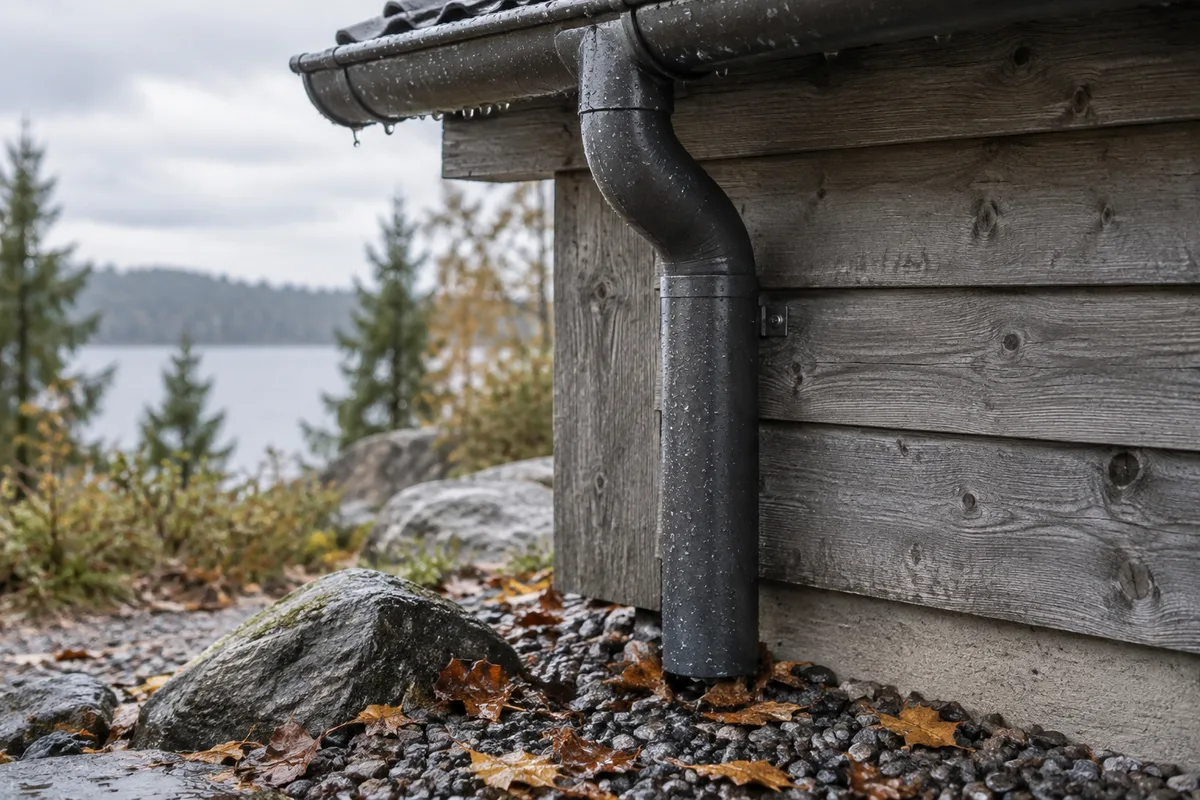
A first-flush diverter sends the beginning of a rainfall event away from your storage tank. It is one part of a roof-water collection system, not a drinking-water treatment system. Choose it around the roof area feeding that downpipe, the space available for a chamber and whether you can reach its drain for maintenance.
This guide compares a conventional chamber with an expanded chamber, then examines one documented US kit. We have not tested it in the field. The useful purchase is the arrangement you can size, fit and service, rather than whichever kit has the largest-looking pipe.
Start with what the water will be used for
Write down the intended uses before shopping: garden irrigation, cleaning, washing, or drinking and cooking. Those are different water-quality decisions. The CDC rainwater guidance explains that apparently clean rainwater can still contain germs and chemicals. It recommends appropriate testing and treatment with local health advice when the water is used for drinking, cooking or bathing.
A first-flush device can reduce what enters a tank at the start of rain. It cannot certify the water after a bird has fouled the roof, remove every dissolved chemical or establish that a storage tank is hygienic. Keep a separate reliable drinking-water supply until the collection and treatment arrangement has been checked.
Use the water-filter selection guide for treatment decisions. Do not count a diverter and a coarse screen as two stages that automatically add up to potable water.
Choose the arrangement that fits the wall
A conventional vertical chamber stores the initial runoff until a floating seal closes its entrance. Later water continues toward the tank. A slow drain empties the chamber between events so it can start again.
An expanded chamber provides more storage per unit of height than a smaller chamber. That may help beneath a low gutter, but the tee, adapters, drain and working clearance still occupy space. A larger diameter does not remove the need to calculate volume.
A compact device with no long chamber is a different design. Before comparing one, check how it measures or controls the diversion and resets between showers. Do not assume a compact housing has the same behavior as a long sealed pipe.
For a cabin visited infrequently, accessible maintenance matters as much as a tidy installation. A drain you cannot inspect from a safe position is a recurring problem, even if the device fits perfectly on paper.
A checked candidate: First Flush Max WDDP112
The Rain Harvesting WDDP112 — opens Amazon US in a new tab is the US First Flush Max with Catch-All Tee variant: a 3-inch inlet/outlet with an expanded 4-inch chamber arrangement. The checked Amazon destination identifies that model, rather than a similarly named electronic-valve kit or another national pipe size.
The manufacturer installation guide lists the supplied fittings and the additional chamber pipe and installation materials. Measure the actual pipe standard before ordering. An existing rectangular downspout needs an appropriate transition; “3 inch” on two products is not sufficient evidence that they join.
This is a candidate when a serviceable vertical chamber suits your layout. Choose something else when the pipe standard is incompatible or the available height cannot accommodate your required volume and access. The kit itself is not a ready-to-install complete roof-to-tank system.
Work from volume to chamber length
First establish the volume to divert for the roof area feeding this specific branch, using the system designer's or manufacturer's site-dependent method. Roof condition, the gap between rainfall events and local contamination all matter. A single universal number would conceal those assumptions.
Then convert volume into chamber length. For a cylindrical chamber, volume equals cross-sectional area times length. Use the actual internal diameter, not the nominal pipe label.
As a purely geometric example, a chamber with a measured 100 mm internal diameter holds about 7.85 litres per metre of straight pipe. If a designer specified 12 litres for that branch, the straight-pipe calculation would be about 1.53 metres. This is not a diversion recommendation, a WDDP112 pipe specification or a complete installed dimension. Fittings, the sealing arrangement and the manufacturer's sizing procedure still need accounting for.
Sketch the result against your wall. Include the gutter outlet, tee, fittings, chamber, brackets, drain and room to remove parts. A kit that is short in its box can become a long assembly after sizing.
Make the discharge and reset visible
The diverted water needs somewhere appropriate to go. Avoid a discharge that creates a slippery path, saturates the cabin footing or simply routes dirty runoff back into the tank. Check local drainage requirements rather than assuming that a hose pointed downhill resolves them.
The slow-release opening is a maintenance item. If it clogs, the chamber may stay full and be unable to catch the next first flush. If it drains too quickly for the intended arrangement, useful collection can be lost. Follow the selected kit's instructions when choosing or servicing its flow-control parts.
Add three observations to your first rain check: does initial runoff enter the chamber, does later flow reach the tank, and does the chamber empty afterward? Record the actual result. Looking at the dry installation cannot establish all three.
Plan arrival, departure and freezing weather
At arrival, inspect the roof-water path, accumulated debris, chamber condition and drain. After maintenance, confirm the device resets. A long unattended interval is a reason to check the system before relying on its water, not a reason to assume automation has kept it clean.
Before freezing conditions, follow the installation's winter shutdown plan. Trapped water and inaccessible low points deserve attention. Do not assume the plastic kit is freeze-proof because it is sold for outdoor use.
Keep a note of the fitting sizes and replacement parts, and make service access part of the installation brief. The arrival and leaving checklist helps turn these observations into a repeatable routine.
Finish the water system decision
Record the branch roof area, chosen diversion volume, actual chamber dimensions, discharge location and reset check in your plan. Mark anything not yet measured as unknown.
Then connect collection to the rest of the system. The water budget deals with how much usable supply a stay needs; the pump guide deals with delivery to fixtures. Neither tank capacity nor pump pressure establishes drinking-water safety.
Buy the diverter only after you can explain where its first water goes, how it resets and who will maintain it. Those answers make the purchase useful long after the first rainfall.
The manufacturer product page provides the current First Flush Max range; use the US model instructions when matching its fittings.
Equipment for this approach
Consider for your setup
Rain Harvesting First Flush Max WDDP112 — 3-inch inlet, 4-inch chamber
A documented US 3-inch inlet kit with an expanded chamber arrangement. Check actual pipe compatibility, required volume, service access and drainage before choosing it.
A first-flush diversion kit with a 3-inch inlet/outlet and an expanded 4-inch chamber arrangement. It diverts initial roof runoff; it is not a drinking-water filter or treatment system.
Suitable for: A roof-water collection system with compatible US pipework and enough accessible vertical space for the chosen diversion volume.
Limits, compatibility & other parts
- Keep in mind
- Not a complete fitted chamber or proof that collected water is safe to drink. It needs cleaning and a drainage route; neglected valves can prevent resetting.
- Check compatibility
- Match the US WDDP112 variant, actual pipe standard and adapters. Calculate chamber length from the required diversion volume and pipe internal diameter. Do not treat nominal 3-inch and 4-inch sizes as measured internal diameters.
- Other parts needed
- Chamber pipe, suitable joining materials, supports and a safe discharge arrangement are required. Check the supplied adapters and current installation guide before buying pipe; plan freezing-weather shutdown separately.
Save this candidate to my plan
Product information checked 25 September 2026. Check current options and availability on Amazon.