The useful question is not which connection looks fastest in a product announcement. It is whether a complete arrangement supports the activities you need at the place and times you intend to use it. A few messages after dinner and a day of client calls create very different briefs.
Separate your needs before comparing providers. This guide helps you design a fair trial, account for power and subscriptions, and decide what to do when the connection is unavailable. It does not recommend a particular current plan or promise coverage at your property.
Describe a successful connected day
List the activities that matter: messages, calls, file transfers, remote work, entertainment or monitoring. Give each one a time window and a consequence if it fails. “Upload the week's photographs sometime before leaving” is flexible. “Join a scheduled work call on Tuesday morning” is much less flexible.
Write down who shares the connection and which activities might overlap. A trial with one phone during a quiet afternoon does not represent two people working while other devices update. Reproduce the ordinary situation as closely as practical, using non-sensitive test material where appropriate.
Decide which activities can happen elsewhere. If you intend to work from a nearby location during an interruption, establish that it is genuinely available when needed. Record the travel involved and what would cause you to abandon that fallback. A backup plan should describe a place and a routine, not simply “find Wi-Fi.”
Use coverage maps to choose trials
Mobile coverage predictions are a useful starting point, but they do not settle performance inside your particular building. Ofcom's reception guidance explains that predicted and experienced coverage can differ and discusses trying other networks. Its advice concerns the UK; use the relevant regulator and providers for your location.
Make a shortlist based on current coverage information, then investigate a suitable low-commitment way to test where available. Check the provider's actual conditions and the compatibility of the intended device. A phone trial can answer some questions, but do not assume it fully represents a different router, antenna or service plan.
Test in the places you will really use the service. Record location, device, provider, date and time. Keep indoor and outdoor observations separate. Avoid mounting or modifying equipment beyond your competence merely to improve a test result; professional advice may be needed for a permanent installation.
Test activities as well as speed
A speed result is one observation. Add a normal call, a representative upload and the applications you expect to use. Record whether the task completed reliably and whether the experience was acceptable to the person doing it. A connection can feel very different during an interactive call than during a download that can wait.
Repeat important tests across the times you care about, within the limits of your trial arrangement. A single successful Saturday afternoon is not a promise about every working morning. Keep failures in the record rather than averaging them away because the best result looks encouraging.
Use a short log: activity, conditions, result, interruption and consequence. For a work trial, also test the organization's required tools and obtain any necessary IT guidance. The definition of “works” should come from the actual job, not solely from a generic benchmark.
Include satellite's site requirements
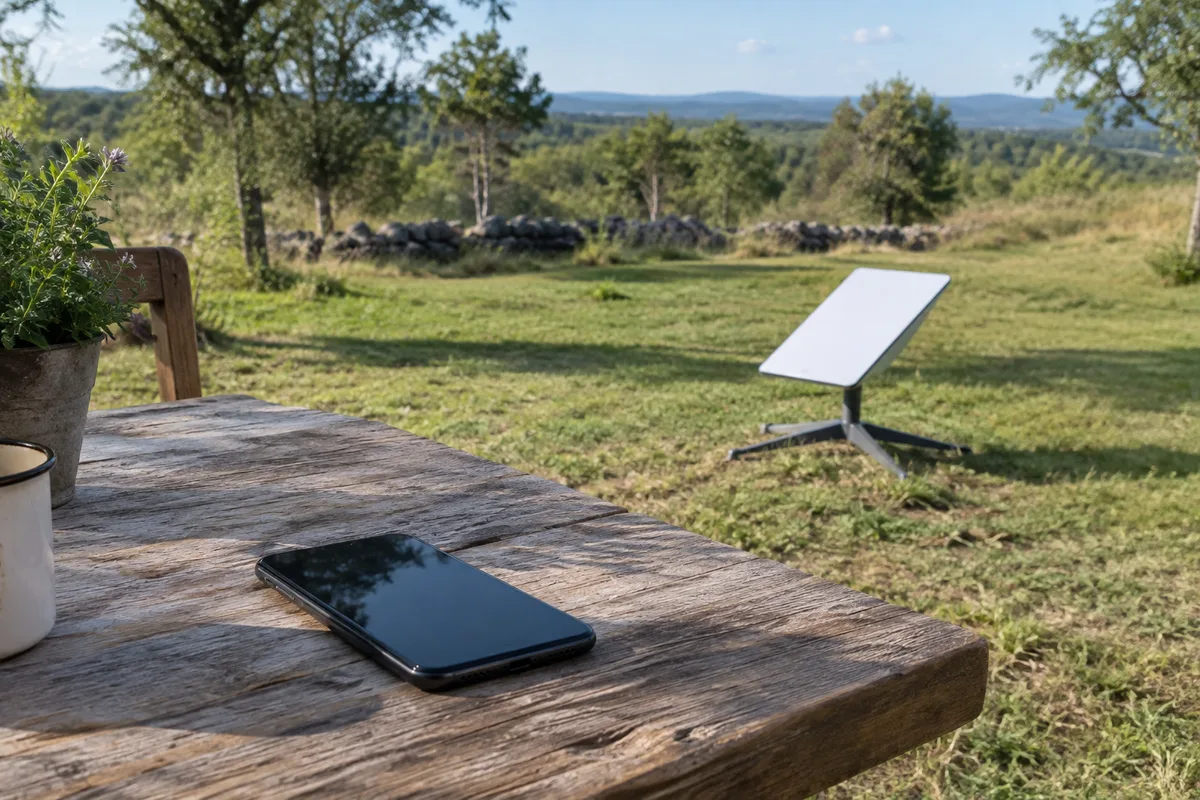
Satellite equipment needs an appropriate position and installation for its specific system. Starlink's obstruction guidance explains that trees, roofs and other obstructions can interrupt the required view of the sky. Use the current assessment tools and instructions for the exact equipment instead of assuming that open-looking countryside is sufficient.
Keep the proposed position connected to the rest of the plan: safe access, mounting, cable route, weather exposure, power and maintenance. If permanent mounting needs professional work, include it in the comparison. A service price alone does not describe the complete setup.
Check availability and plan conditions for the location and intended use at the time you decide. Record the date and source of the information. Do not rely on another owner's older subscription terms, particularly for pausing, moving equipment, data allowances or cancellation.
Compare the whole cost and power routine
Make separate rows for equipment, installation, recurring service, accessories and expected replacement or support needs. Keep uncertain costs visibly open. If one option includes equipment and another does not, adjust the comparison before judging the monthly price.
Add the complete setup to your energy audit. Record actual intended operating hours: occasional use, a working day or continuous monitoring. Use the exact equipment documentation and suitable measurements rather than treating its power supply rating as a constant consumption figure.
Think through arrival. Does anything need setting up before a call can begin? What remains running while you are away? A portable arrangement and a permanently installed one create different routines. Choose between them partly on how you want to use the place, not only on a specification sheet.
Make a decision with conditions attached
Write a short result such as “suitable for our evening messages in the tested conditions; a full workday remains untested.” This preserves what you learned without claiming more. Decide which additional evidence would justify a longer commitment or a change in equipment.
- Which required activities worked during realistic trials?
- Which times, seasons or conditions remain untested?
- What is the full equipment, service and power commitment?
- What will you do if the connection is unavailable?
- Who checks changing terms before renewing or expanding?
Keep critical communication needs separate from ordinary internet convenience and obtain appropriate local advice on dependable alternatives. If the connection will support unattended sensors, continue with monitoring a cabin while away. That introduces a different question: whether anyone can act on the information received.